Auto loans in 2026 are longer and more expensive than they used to be, which makes it easier to end up owing more than your car is worth—but with the right rate, term, and down payment, you can keep equity on your side and avoid feeling trapped in the loan.
Why car loans feel heavier now

Car prices and borrowing costs both climbed over the last few years, and the typical new‑car loan now runs close to six years, not five. Cars also depreciate quickly, often losing more than half their value within five years, so a long loan can outlast a big chunk of the car’s worth.
To keep monthly payments “affordable,” lenders have stretched terms to an average of about 69 months for new cars and around 68 months for used cars, which means more total interest and slower equity building. That’s the emotional gap many buyers feel: “I need a car to live my life” versus “I don’t want this payment hanging over me for six or seven years.”
The same pressures show up in many countries even if the names of products and paperwork differ—high prices, fast depreciation, and long terms all create the risk of being stuck with a loan that outlives the joy of the car. Before you shop, ask yourself: How many years do you realistically keep a car?
How an auto loan actually works
At its core, an auto loan has four moving parts: principal (the amount you borrow), interest (the cost of borrowing), term (how long you have to repay), and your monthly payment (how those pieces are spread out over time). When you finance, you’re paying for the car plus the cost of the money, and sometimes fees and add‑ons that get folded into the loan amount.
The interest rate is the percentage the lender charges on the principal, while the APR (annual percentage rate) includes that interest rate plus certain lender fees and finance charges, giving a more “all‑in” yearly cost of the loan. Because APR bakes in mandatory fees, it’s usually higher than the simple interest rate and is the better number for comparing offers with the same term and amount.
Auto loans are amortizing, which means your payment stays the same but early payments go more toward interest and less toward principal; later in the term, more of each payment actually reduces what you owe. New vs. used, and dealer financing vs. bank/credit‑union/online lender, all affect both the rate you’re offered and the fees wrapped into the APR.
Quick check before you commit: Look at both the interest rate and the APR on the disclosure, and note the total of payments line—that’s what the loan really costs you over time.
What drives rates in 2026
In early 2026, average auto loan rates in the U.S. hover around 6–7% APR for new cars and roughly 10–11% for used cars, but the spread by credit score is huge. Experian data shows that borrowers with “superprime” scores (781+) see new‑car APRs around 4.5–4.6%, while deep subprime borrowers (under 500) can face rates above 16% for new and over 21% for used.
Your credit score, loan term, whether the car is new or used, the size of your down payment, and where you finance (dealer vs. bank/credit union/online lender) all push your individual rate up or down. Credit unions are often among the cheapest, averaging new‑car rates around 5.2% in 2026 for qualified borrowers, while dealer financing and some banks can run a percentage point or more higher for the same buyer.
“Special rate” offers on the window or in ads—like 0% or low promo APR—can be great, but they often apply only to specific models, top‑tier credit scores, or shorter terms, and may be paired with fewer discounts on the car’s price. That’s why getting pre‑approved with a bank or credit union first is powerful: you walk in knowing the rate and amount you qualify for instead of hoping the dealer’s finance office treats you kindly.
Quick check before you commit: Get pre‑approved with at least one non‑dealer lender and bring that offer with you—then ask the dealer to beat that APR and total cost, not just give you “whatever they can get.”
Choosing the term: the trade‑off most people underestimate
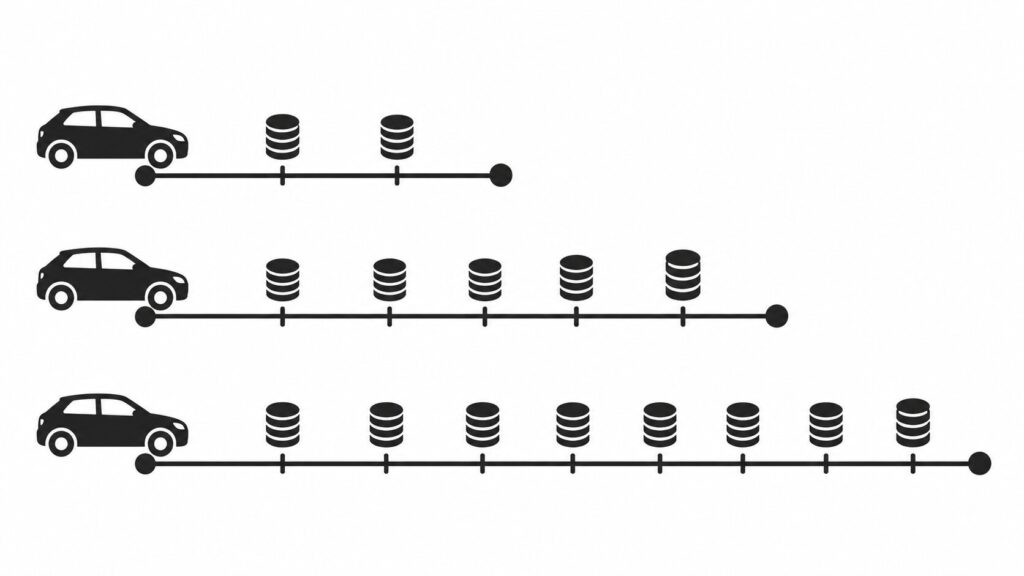
Most lenders now offer car loans in 12‑month steps from 24 up to 84 months, and sometimes even 96 months, with 60 and 72 months being the most common. Longer terms drop your monthly payment but extend how long you’re paying interest, which increases total cost and keeps you closer to being upside down for longer.
For example, Experian shows that a $36,000 loan at 6.37% APR over 84 months has a monthly payment around $532 but racks up more than $8,700 in interest; a shorter term at the same rate would cost noticeably less overall. Cars.com notes that stretching a $35,000 loan at 5% APR from 60 to 84 months adds over $1,900 in extra interest—money you’re paying just for time, not for more car.
Because the car is losing value while you’re paying slowly, a 72‑ or 84‑month term increases the window where you may owe more than the car is worth, especially if you put little down. A shorter term (say 36–60 months) costs more each month but builds equity faster, which gives you more flexibility if your life or job changes.
Quick check before you commit: Run the payment and total interest for at least two terms—like 60 vs. 72 months—and ask yourself, “Will I still want or need this car for the entire term I’m choosing?”
What “upside down” really means
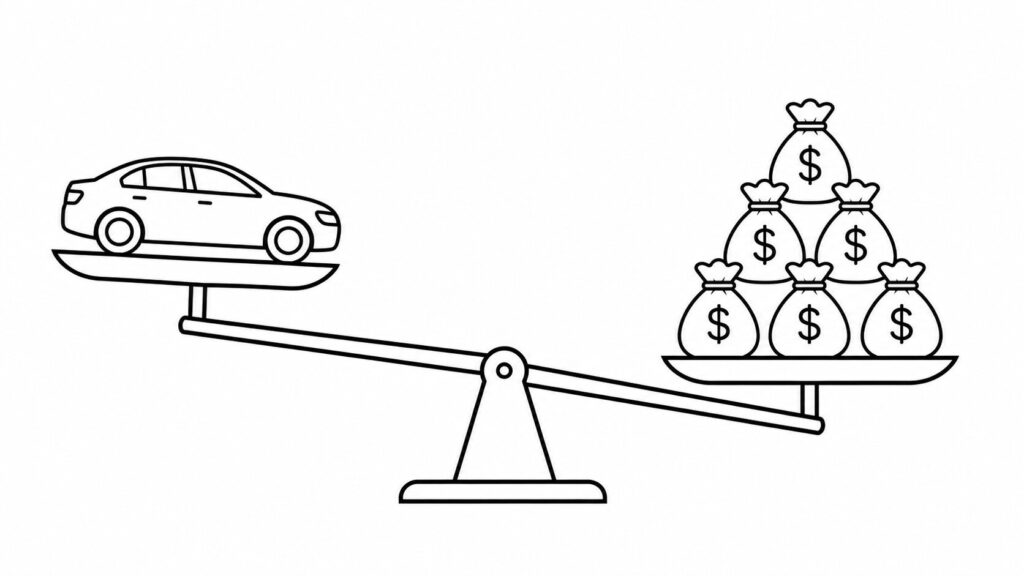
You’re upside down on a car loan when your outstanding loan balance is higher than the car’s current market value—this is called negative equity, being “underwater,” or “upside down.” If your payoff is ₹15 lakh (or $15,000) but the car would only fetch ₹12 lakh ($12,000) in trade‑in or sale, you’re upside down by ₹3 lakh ($3,000).
This matters because if you try to sell or trade the car, the buyer’s money won’t fully cover the loan, and you’ll have to bring cash to close the gap or roll that negative equity into a new loan. It’s especially painful if the car is totaled: insurance usually pays the car’s value, not your loan balance, so you can be left making payments on a car you no longer have unless you had gap coverage.finance.
A lot of people only realize they’re upside down when they go to trade in or after an accident—the worst possible times to discover it.finance.
Quick check before you commit (or right now): Look up your car’s trade‑in value on a site like Kelley Blue Book or Edmunds, then subtract that from your current payoff quote from the lender—if the result is positive, that’s your negative equity.
Why upside down happens
Several common choices combine to create negative equity: long loan terms, small or zero down payments, rapid early depreciation, and rolling old negative equity or add‑ons into a new loan. New cars typically lose value fastest in the first couple of years, so if you’re paying slowly on a long term, the car’s value can drop faster than the balance.
Financing taxes, registration fees, extended warranties, service contracts, and dealer add‑ons into the loan all increase the amount you owe without increasing the car’s resale value, which worsens the loan‑to‑value ratio from day one. Rolling negative equity from your old car into the new loan—say, being ₹4 lakh upside down and adding that to the next loan—means you start the new loan already underwater.
Low down payments are a big driver: experts often recommend at least 20% down to roughly match the car’s immediate depreciation and reduce the risk of starting upside down.
Quick check before you commit: Add up everything being financed (car price, taxes, fees, add‑ons, old loan balance) and compare it to the car’s actual value—if that total is higher, you’re starting the loan upside down.
How to stay right‑side up (or get there faster)
The cleanest way to stay out of negative equity is to combine a meaningful down payment, a term you can afford that isn’t overly long, and a car that’s priced within your budget—not just within the lender’s approval limit. A down payment of around 20% is often cited as a good target; it lowers the amount you borrow and helps offset initial depreciation.
Choosing a shorter term (say 36–60 months for new, 24–36 months for used) reduces total interest and helps you build equity faster, even though the monthly payment is higher. Not stretching for more car than you need—skipping luxury trims or a bigger engine you don’t use—keeps both the price and loan smaller, which is a quieter kind of freedom.
Be careful with add‑ons (extended warranties, gap sold by the dealer, coatings, accessories) that are financed into the loan; they raise your loan amount more than they raise the car’s resale value. Instead, consider buying a reliable used or certified pre‑owned car with eyes open: check repair history, warranty coverage, and depreciation patterns, but remember that a slightly older car can dramatically reduce how much you have to borrow.
Gap coverage is worth considering only if your loan balance is likely to be higher than your car’s value for a while—for example, low down payment, 72+ month term, or rolled‑in negative equity. If you do need gap, buying it cheaply through your auto insurer is usually far better than financing a big lump‑sum gap premium at the dealership.
Once you have the loan, making occasional extra principal payments—monthly or when money allows—can shorten the term and reduce both interest and time spent upside down, as long as your lender applies extra payments to principal and doesn’t charge prepayment penalties.
Quick check before you commit: Ask the finance person to show you the numbers with a bigger down payment and a shorter term—even if that means a simpler car—and compare how quickly you reach positive equity in each scenario.
A simple process to follow before you sign
A little structure before you sign can turn a stressful purchase into one competent decision you don’t have to second‑guess every month.
- Get your credit picture. Pull your credit reports, check your score, and fix any errors so you’re not overpaying because of incorrect information.
- Set your real budget. Common rules of thumb suggest keeping total car expenses (payment, insurance, fuel, maintenance) at or below 15–20% of take‑home pay, and the payment itself at around 10–15%.
- Get pre‑approved. Apply with at least one bank or credit union for a pre‑approval that states your rate, maximum amount, and term; try to submit multiple applications within a short window so they count as one inquiry.
- Decide your max payment and max total price. Base this on your actual budget, not the approval limit—this is your line in the sand before any negotiation.
- Shop the car and the loan separately. Negotiate the car’s price first, using your pre‑approval like a cash offer, then see if the dealer can beat your financing without raising the car’s price or hiding fees.
- Read the contract slowly. Confirm the term, interest rate, APR, total of payments, and the total amount financed, including any add‑ons, taxes, and fees.
- Take one last pause. Before you sign, ask yourself: “If my situation changed next year, would this loan still feel manageable?” That pause is worth more than any free floor mats.
Quick check before you commit: Make sure the deal you’re about to sign fits the budget you set in step 2, not the maximum the lender or dealer says you “qualify” for.
After you have the loan
Once you’re driving the car, your focus shifts to managing the loan rather than negotiating it. If rates fall or your credit improves, refinancing into a shorter term or lower APR can make sense—especially if you can drop years off the loan or cut interest significantly without extending the term.
To see whether you’re upside down at any point, compare your current payoff amount from the lender with your car’s trade‑in value from a pricing guide; the difference tells you your negative or positive equity. If you’re negative but can afford it, extra principal payments and simply keeping the car until the loan is paid off are straightforward ways to get right‑side up over time.
If your situation changes—job loss, income drop, need to sell—contact your lender early; some will discuss hardship options, restructuring, or refinancing, and the more equity you’ve built, the more choices you’ll have.finance.
Quick check now: Set a reminder once a year to check your loan balance versus the car’s value—if you’re in positive equity and the car’s still serving you well, you’re in a good place.
FAQs
What does it actually mean to be upside down on a car, and how do I know if I am?
Being upside down means your loan balance is higher than the car’s current market value—negative equity. To check, get your payoff quote from the lender, look up your car’s trade‑in value, and subtract the value from the payoff; if the payoff is higher, the difference is how far upside down you are.
If you sold the car for that trade‑in value, you’d still owe the gap to the lender, and if the car were totaled, your insurance payout might not cover the entire loan. That’s why understanding your equity position before you try to sell or trade is so important.
Is a 72‑ or 84‑month loan ever a good idea, or should I just stay away?
Long‑term loans (72, 84, even 96 months) shrink the monthly payment but almost always increase total interest and keep you at higher risk of negative equity for longer. Experian explicitly warns that 72‑, 84‑, or 96‑month loans usually aren’t a good idea because they can leave you owing more than the car is worth, especially once the car has depreciated for five or more years.
That said, if you must use a longer term to make a modest, reliable car fit your budget—and you’re putting a decent amount down and plan to keep the car long‑term—it can be a reasonable compromise, not a moral failure. The key is to avoid pairing long terms with tiny down payments and expensive cars, and to consider making extra principal payments when you can.
How much should I put down so I don’t end up owing more than the car is worth?
Many consumer finance sources recommend a down payment of at least 20% to roughly offset the rapid depreciation that happens in the first couple of years and reduce the risk of starting upside down. More is better if the car depreciates quickly (luxury models, certain EVs), you’re taking a longer term, or you’re rolling any amount from a previous loan into the new one.
If 20% feels high, run scenarios: see how 10%, 15%, and 20% down change your loan amount and payment, and how quickly you cross into positive equity. Even outside the U.S., the logic holds—more down means less borrowed and more buffer against price drops.
The dealer said they can get me a better rate—should I just let them handle the financing?
Dealer financing can sometimes beat your bank or credit union, especially when a manufacturer is running a genuine promotional rate (like 0% APR on a specific model for qualified buyers). But dealer finance offices are also allowed to mark up the lender’s base rate as their compensation, so without a pre‑approval to compare against, you may not know if the “better” rate is actually better.
The smart move is to get pre‑approved first, then let the dealer try to beat that offer; if they legitimately beat your APR and total cost, use their financing, otherwise stick with your original lender. Never let the dealer blend price and payments into one negotiation—lock in the car’s price first, then talk financing.
What’s the difference between the interest rate they quote and the APR?
The interest rate (sometimes called the note rate) is the percentage charged only on the principal you borrow; it doesn’t include fees. The APR is the interest rate plus most mandatory lender fees and certain finance charges, expressed as a yearly percentage, so it reflects more of the total cost of borrowing over the term.
Because APR folds in fees, it’s usually higher than the simple interest rate and is the best apples‑to‑apples comparison when you’re weighing two loans with the same term and amount. Optional add‑ons like gap insurance or extended warranties often don’t show up in APR but still increase your loan amount, so you should watch the total amount financed as well as APR.
If I already have a loan and I’m upside down, what are my options?
If you’re upside down, you can:
- Keep making on‑time payments and let normal amortization gradually bring you back to positive equity.
- Make extra principal payments if your budget allows and your lender applies them correctly, which speeds up equity building.
- Refinance into a shorter term or lower rate if your credit has improved or market rates are better, but be careful not to extend the term in ways that keep you underwater longer.
If you need to sell or trade in while still upside down, you’ll likely have to bring cash to cover the negative equity or roll it into the next loan—which may be necessary but sets you up to start the new loan underwater.finance.
Does any of this work the same if I’m buying outside the US?
The labels (APR rules, credit bureaus, dealer practices) differ from country to country, but the underlying mechanics are the same almost everywhere: you borrow a principal amount, pay interest over a term, the car depreciates, and your equity is the gap between value and what you owe. Whether you’re in India, Europe, or elsewhere, the same risks apply—small down payments, long terms, and add‑ons financed into the loan all increase the chance you’ll be upside down.
What changes is how rates are quoted (flat vs. reducing balance), how credit is scored, and which fees are regulated, so always read local disclosures and ask lenders to spell out total cost, not just monthly payment.
Should I pay extra every month or just stick to the regular payment?
Paying extra toward principal—above your scheduled payment—reduces your balance faster, lowers total interest, and shortens the time you spend at risk of negative equity, as long as the lender applies extra payments to principal and doesn’t penalize you. If your loan has a long term or a higher rate, even modest extra payments can shave months off the term.
Sticking to the regular payment is fine if your budget is tight and you chose a responsible term and down payment upfront; there’s no virtue in over‑stretching just to pay off faster if it puts your daily life at risk. The key is aligning your payment plan with your actual income and how long you plan to keep the car.
Final practical check: Before you sign—or before you decide whether to pay extra—ask yourself: “Am I choosing a loan that gives me options later, or one that leaves me stuck if anything changes?” The more equity you build and the less total interest you commit to, the more that loan will feel like a solid adult decision instead of a monthly weight.