Credit card balance transfers can be powerful tools for escaping high-interest debt when used with a clear payoff plan, but they can quietly backfire if treated as a form of breathing room rather than a deadline. Most promotional offers in the U.S. market give 0% APR on transferred balances for 12–21 months and charge a one-time transfer fee of around 3–5% of the amount moved, which must be weighed against the interest that would otherwise be paid. The core decision is simple: a balance transfer saves money if the interest avoided during the promo window is greater than the fee and any residual interest, and if no new debt is added while the balance is being paid off.
Why Balance Transfers Feel Like a Lifeline
High-interest credit card debt creates a double burden: payments barely dent the principal while interest accumulates, and the psychological weight of watching the balance barely move can feel exhausting. A 0% balance transfer offer looks like an escape hatch because it promises a period where every payment goes toward principal instead of interest, often advertised as 12–21 months of relief. This creates a common hope: if interest can be paused long enough, it may finally be possible to clear the debt, but the same offers can also be structured to generate fee income for issuers when cardholders don’t finish paying before the promo ends.
How a Balance Transfer Actually Works
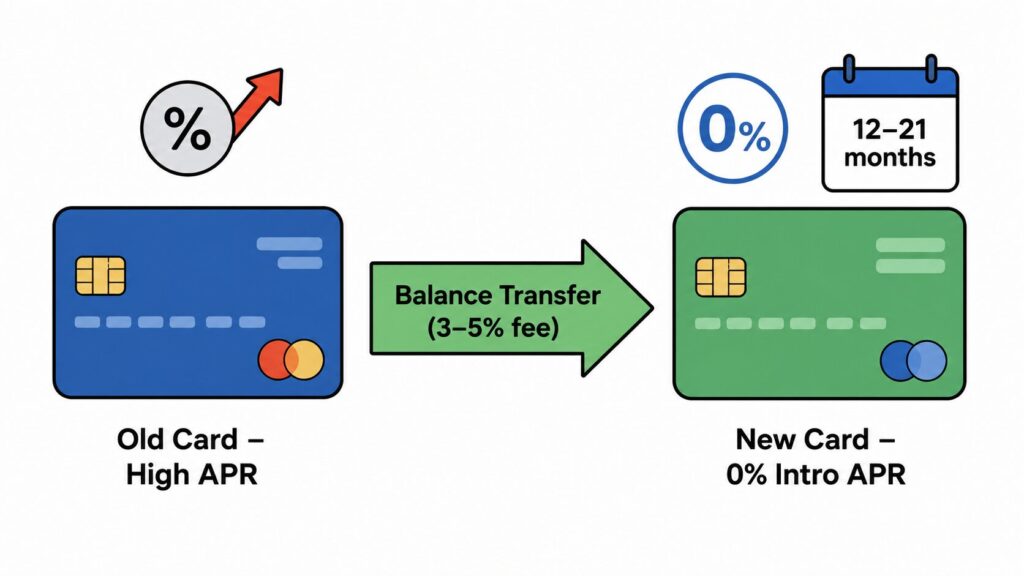
A balance transfer lets a cardholder move existing credit card debt from one card to another, typically to a new card offering a promotional 0% APR on transferred balances for a limited time. The new issuer pays off the old card directly, adds a balance transfer fee to the transferred amount (usually 3–5% with a minimum $5–$10), and the cardholder then makes payments to the new card at the promotional rate. The promotional 0% APR applies to transferred balances during the window but usually does not apply to new purchases, which accrue interest at the regular APR, and remaining balances after the promo ends begin accruing interest at a standard rate often between 17–29% or higher.
Typical Terms and Mechanics
Most 0% balance transfer cards charge a one-time fee between 3% and 5% of the amount transferred, added directly to the new card’s balance. Industry data shows that 3% fees remain common, but 4–5% fees have become more frequent on 0% offers, with roughly half of surveyed cards charging 3% and a growing share charging 4–5%. Promotional 0% APR windows are typically 12, 15, 18, or 21 months, with some credit union products extending to 24 months, and transfers generally must be initiated within a specified window from account opening (often 60–120 days) to qualify for the intro rate. After the promo window, any unpaid transferred balance starts accruing interest at the card’s regular APR, usually in the high teens to high 20s, and missing a minimum payment can cause the promotional APR to terminate early.
How Payments Are Applied
During the promotional period, payments made to the balance transfer card are applied first to the lowest-rate balance under U.S. rules, which means payments go toward the 0% transferred balance before touching higher-rate purchase balances on the same card. Because new purchases accrue interest at the regular APR and payments are applied to the 0% balance first, using the transfer card for new spending can leave those purchases accruing interest for months while payoff efforts focus on the transferred balance. Once the promotional window closes, the remaining transferred balance and any purchase balances both accrue interest at their applicable APRs, and minimum payments may barely cover interest, causing payoff timelines to stretch out again.
Simple Math: When the Fee Is Worth It
The core math test is whether the total interest avoided by paying 0% on the transferred balance during the promo window exceeds the one-time transfer fee. A typical fee formula is fee=transfer amount×fee percentage with a minimum dollar amount, so a 3% fee on $5,000 is $150 and a 5% fee on $5,000 is $250, and those amounts are added to the new balance immediately. If the cardholder would otherwise pay many months of interest at 20–25% APR on the current card, avoiding that interest for 12–21 months while aggressively paying down principal often yields savings that far outweigh a 3–5% fee, provided the balance is substantially or fully cleared within the window.
When a Balance Transfer Genuinely Saves Money
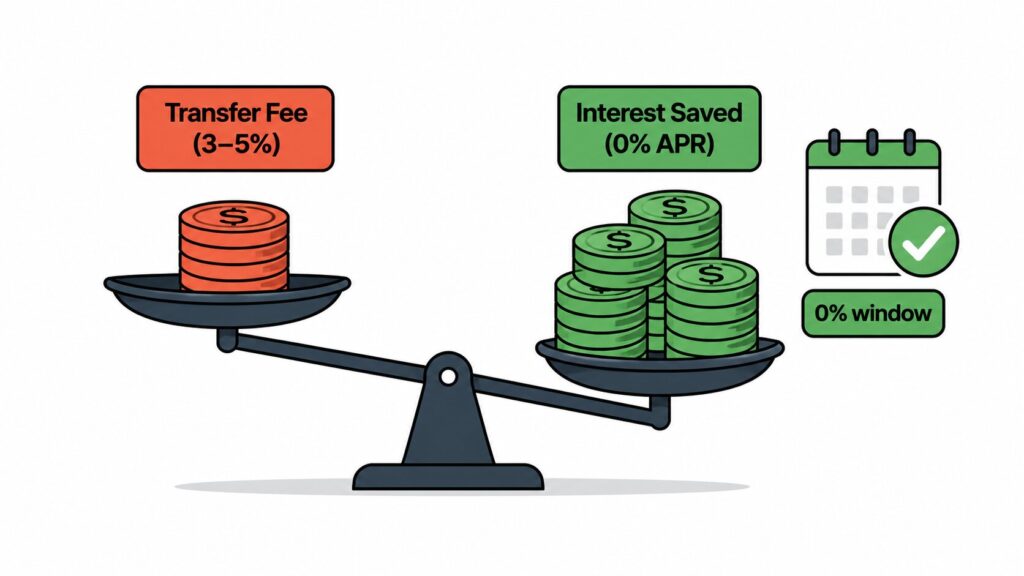
Balance transfers most clearly save money when the cardholder has a realistic plan to pay off the full transferred balance before the promotional 0% period ends and stops using the old cards for new spending. Good offers typically require strong-to-good credit scores (often 670+ or better) and provide enough promo months that, with consistent payments, the balance can be retired before the regular APR kicks in. Treating the new card as a payoff-only tool—no new purchases during the promo window—and combining it with a fixed monthly payment schedule that clears the total (including the fee) is the pattern that produces real interest savings.
Concrete Example: Interest Avoided vs. Fee Paid
Consider a cardholder with $5,000 in credit card debt at a 24% APR on their current card. If they keep the balance on the existing card and pay $300 per month, roughly $100 of each payment would initially go to interest, and they could pay more than $1,000 in interest over 12 months. If instead they transfer the $5,000 to a card with a 0% intro APR for 12 months and a 3% transfer fee, the fee is $150, making the new balance $5,150, and paying about $430 per month would retire the balance in 12 months with virtually no interest on the transferred amount. In this scenario, the cardholder trades $150 in upfront fee for more than $1,000 in avoided interest, clearly coming out ahead if they stick to the payoff schedule.
Longer Windows and Larger Debts
For longer promotional windows (such as 18 or 21 months), a balance transfer can be even more advantageous for larger balances because more months of high-interest charges are avoided. The break-even condition can be approximated as current APR×(window in months/12)>fee percentage, meaning that at a 3% fee and an 18-month window, the current APR only needs to be modestly above 2% per year for the interest avoided to exceed the fee. Since most revolving credit card APRs are far higher than this, balance transfers under long 0% windows tend to save money if the cardholder doesn’t add new debt and pays the balance down consistently.
When a Balance Transfer Quietly Makes Things Worse
Balance transfers can become traps when a large portion of the balance remains at the end of the promotional period and immediately begins accruing interest at a high regular APR. If the cardholder continues using the old cards for purchases after the transfer, the total debt may grow even while the transferred balance is slowly falling, leaving them with more debt spread across multiple cards. In some cases, the combination of transfer fees, post-promo interest on remaining balances, and ongoing spending can result in higher total costs than simply attacking the original card balances with an aggressive payoff plan.
Common Pitfalls
One frequent mistake is treating the lower minimum payment on the 0% card as permission to relax, making only the minimum and spending the freed-up cash elsewhere rather than using the promo window to accelerate payoff. Another is making new purchases on the transfer card, which accrue interest at the regular APR while payments are applied first to the 0% transfer balance, leaving the purchase balance to generate interest for a long time. A third pitfall is missing a minimum payment, which many card agreements treat as a trigger to cancel the promotional APR and apply the standard rate to the entire transferred balance, instantly eroding the savings.
When Fees and Offers Are Poor
Balance transfers can also be poor deals when only shorter promo windows or higher-fee offers are available, especially if the cardholder cannot pay down the debt quickly. Industry analysis shows that a rising share of 0% balance transfer card offers now charge 4–5% fees rather than the traditional 3%, increasing the cost of moving debt. When combined with standard regular APRs in the high teens or higher, a short promo period with a high fee may save little or no money compared with simply focusing payments on a high-interest card without paying a transfer fee.
The Real Decision Framework
A practical decision framework for a balance transfer centers on three questions: whether the balance can realistically be cleared before the 0% window closes, whether the cardholder will stop adding new debt to the old cards, and whether the transfer fee is small enough that the interest avoided clearly outweighs it. The cardholder can answer these questions by running simple calculations on their current balances, APRs, and monthly payment capacity, and by being honest about spending habits and discipline. When the answers show that the promo window is too short, the fee too high, or spending behavior unlikely to change, alternatives such as direct payoff strategies or structured counseling may be safer than another card move.
How to Run the Numbers in 10 Minutes
The cardholder can start by listing each credit card balance and its current APR, then identifying the highest-rate cards. Next, they can look up current balance transfer offers, focusing on the promo length, fee percentage, and regular APR, and then plug their balances into a basic payoff calculation: total transferred amount plus fee divided by promo months equals the required monthly payment to retire the debt before the window ends. Comparing this required payment to their actual monthly capacity shows whether the transfer is feasible; if the required payment is far above what’s realistically affordable, a different strategy—such as the debt avalanche (prioritizing highest APR) or snowball (smallest balance first)—might be more appropriate.
Alternatives When the Answer Is No
When a balance transfer doesn’t pass the math or behavior tests, focusing directly on existing cards is often the next-best option. The debt avalanche method—paying extra toward the highest-APR card while making minimums on others—maximizes interest savings, while the debt snowball method—paying extra toward the smallest balance—can provide faster psychological wins that encourage persistence. Other alternatives include hardship programs offered by some issuers, nonprofit credit counseling organizations that can help negotiate lower rates or structured repayment plans, and in some cases personal loans with fixed terms and lower APRs, which can simplify the payoff journey, though personal loan terms vary by market and borrower profile.
How to Execute a Transfer Without Common Mistakes
Executing a balance transfer well requires careful reading of the full terms, attentive timing, and disciplined payment behavior. Before initiating a transfer, the cardholder should understand the promotional APR length, the exact balance transfer fee, the regular APR after the promo, and any penalty triggers that can end the promo rate early. Timing the transfer so that it occurs early in the promo window and not at the last minute reduces the risk of missing the opportunity, and setting up automatic payments for at least the required monthly amount helps prevent missed payments that could cancel the promo.
Steps to Execute a Smart Transfer
Key steps include applying for the balance transfer card if needed, requesting the transfer within the issuer’s defined window, and verifying that the transfer has posted to both the old and new cards. Once the balance has moved, the cardholder should set a fixed monthly payment schedule that will clear the total (including the fee) before the promo end date, and mark that date on a calendar or reminder system. As for the old cards, best practice is usually to stop using them for new purchases; whether to close them entirely depends on credit score considerations and self-control, as keeping them open with a zero balance can help credit utilization but also leaves a doorway to future spending.
After the Transfer: Staying Free
After completing a balance transfer, staying free from high-interest debt means maintaining the payoff schedule and avoiding the behaviors that caused the debt in the first place. Building a simple payoff plan—monthly payment amount, target payoff date, and rules about new purchases—helps keep the promo window framed as a deadline rather than a vague grace period. If income changes or emergencies arise, revisiting the plan quickly, adjusting payments where possible, and considering backup strategies (such as reducing discretionary spending or seeking temporary hardship assistance from issuers) can prevent slipping back into revolving debt.
Avoiding the Cycle Going Forward
Once the balance is gone, avoiding repetition of the cycle involves using credit cards primarily as payment tools rather than borrowing tools and paying statement balances in full each month whenever possible. Maintaining an emergency fund, even a small one, can reduce the need to lean on credit cards when unexpected expenses appear. Limiting the number of promotional cards and resisting the temptation to repeatedly roll balances from one promo offer to another helps keep progress real rather than just reshuffling debt, and using budgeting or tracking tools can support more intentional spending.
International Note: Outside the United States
Balance transfer products with low or 0% promotional rates exist in several countries, including markets such as the U.K. and India, but specific fees, regulations, and offer structures differ by jurisdiction and issuer. In some markets, balance transfer fees may still be in the 3–5% range and promo periods may vary; in others, promotional rates may be less common or more tightly regulated. Despite these differences, the core decision logic remains similar: whether the interest avoided during the promotional window exceeds the fee and costs, and whether the cardholder can realistically pay the balance down without adding new debt.
FAQs
Is a balance transfer actually worth it if they charge a 3–5% fee?
A balance transfer is usually worth the 3–5% fee when the cardholder carries a meaningful balance at a high APR and needs more time to pay it off, because avoided interest over the 0% window often exceeds the fee. Many analyses consider a 3% fee reasonable and often worthwhile on sizable balances, and even 5% fees can be justified in some cases when the current APR is very high and the promo window long enough. The key is to compare the one-time fee with the amount of interest that would be paid on the existing card over the same period if the balance is not transferred.
What happens if I still have a balance when the 0% period ends?
Any remaining transferred balance at the end of the 0% promotional period starts accruing interest at the card’s regular APR, which is often between about 17–29% and can quickly increase the cost of carrying the debt. From that point, minimum payments may again primarily cover interest, extending payoff timelines unless the cardholder continues making aggressive payments. Some card agreements may also treat certain triggers, such as missed minimum payments, as reasons to end the promotional APR early, causing the regular rate to apply sooner.
Will doing a balance transfer hurt my credit score?
Applying for a new balance transfer card can result in a hard inquiry and potentially reduce the average age of accounts, which may temporarily affect credit scores. On the other hand, transferring a balance and then paying it down can lower credit utilization over time, which is generally positive for credit scores if the cardholder avoids new debt and missed payments. Keeping old accounts open with zero balances can help utilization metrics but requires self-control to avoid using them again, while closing them can reduce available credit and raise utilization ratios if other balances remain.
Can I transfer multiple cards onto one new card?
Many balance transfer cards allow multiple balances to be moved from different cards and lenders, subject to the new card’s credit limit and transfer policies. The total transfer, including the fee, cannot exceed the new card’s credit limit, so a high fee and large combined balances can constrain how much can be moved. Checking issuer terms and using the new card’s limit as a ceiling helps avoid partially completed transfers or declines.
What if I get approved but the credit limit isn’t high enough for my whole balance?
If the new card’s credit limit is too low to cover all intended transfers plus the fee, the cardholder may need to prioritize which balances to move, often focusing on the highest APR debts first. Any remaining balances on other cards can still be attacked using avalanche or snowball payoff strategies. In some cases, issuers may consider limit increases after some time and responsible usage, but such decisions are not guaranteed and depend on credit profiles and issuer policies.
Should I close the old cards after I transfer the balances?
Closing old cards after a balance transfer can reduce future temptation to spend but may negatively affect credit utilization and the average age of accounts, both factors in credit scoring models. Keeping old cards open with zero balances can support a lower utilization ratio, which can be positive for scores, provided the cardholder is confident they will not resume using those cards for new debt. The decision can be made based on personal discipline and credit goals, balancing long-term score impact against the need for behavioral safeguards.
Is this a better idea than just paying extra on my current cards?
When the cardholder can afford aggressive payments and the current APRs are not extremely high, simply paying extra on existing cards using avalanche or snowball methods can be straightforward and avoids transfer fees. A balance transfer becomes more attractive when APRs are high and the cardholder needs time to pay off balances without accumulating further interest, provided the transfer fee and promo terms make mathematical sense. The choice depends on the available offers, the cardholder’s payoff capacity, and discipline in avoiding new debt during the payoff period.
Do these offers work the same way if I’m not in the United States?
Outside the U.S., similar balance transfer and low-rate promotional products exist in several markets, though their prevalence, fees, and regulatory frameworks differ by country and issuer. Some markets may offer longer or shorter promo periods, different typical fee percentages, or stricter rules about how balance transfers can be used. Regardless of the jurisdiction, the fundamental questions—about whether the interest avoided exceeds the fee and whether the cardholder can pay down the balance without adding new debt—remain relevant.