You can stay safe from AI-generated financial scams and deepfake voices by focusing less on how “real” the call or video looks and more on what the person is asking you to do, especially around money and secrecy.
Why these scams feel different
AI has made it possible to clone a voice or face from just a few seconds of audio or video, so the scam no longer feels like a stranger calling — it feels like your child, your parent, your boss, or your bank speaking directly to you.
Scammers combine that familiarity with urgency (“right now”), fear (“I’m in trouble”), and secrecy (“don’t tell anyone”), which is why even careful, tech-savvy people get caught.
Have you or someone in your family already had a call that felt a little off, but you couldn’t quite say why?
Action for this week: Notice when a call or message makes you feel rushed or afraid; treat that feeling itself as a warning sign.
How AI scams target you in 2026
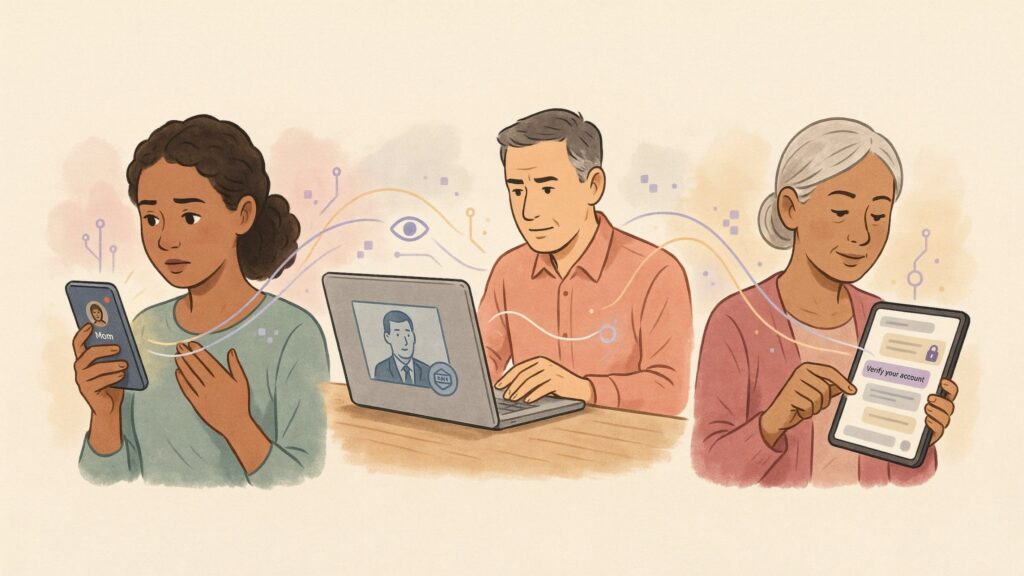
Around the world, AI-enhanced scams have become one of the fastest-growing forms of fraud, with voice cloning and deepfake video now used in family emergencies, bank impersonations, and executive-payment scams according to FBI IC3 reports on AI-enabled distress scams.
You’ll see similar patterns whether you’re in the US, India, Europe, or elsewhere — the names of agencies or banks may change, but the emotional script is the same.
Common patterns:
- A “family member” calling in a familiar voice about an accident, arrest, kidnapping, or medical emergency, demanding immediate payment via wire, crypto, or gift cards.
- A deepfake video or voice claiming to be your bank, employer, or a government official, giving urgent instructions to move money or share codes.
- Messages or emails that look exactly like they come from a company you already use, asking you to “verify your account” or “secure your funds” by clicking a link or sending money.v
Action for this week: Make a short list of the legitimate channels you use for your bank, main apps, and employer (official website, app, known phone numbers).
Warning signs that actually matter
Because deepfakes can defeat human judgment — and even professional detectors — trying to “spot the fake” visually or by ear is no longer reliable.
The safest approach is to focus on the nature of the request, especially when it involves money, secrecy, or breaking your normal routine.
Key red flags:
- Unusual urgency (“you must act in minutes”) or insistence that you keep the conversation secret.
- Requests to move money, buy gift cards, send crypto, or share one-time codes, passwords, or PINs.
- Small inconsistencies in the story, timing, or details that someone close to you would normally know (wrong nickname, odd choice of words, unfamiliar backstory).
- Pressure to switch to a new app, unknown payment method, or unfamiliar link instead of your usual bank app or website.
- Resistance or anger when you say you want to verify their identity or call back on another number.
Action for this week: Decide your personal rule: “Any urgent request involving money or codes is an automatic pause, no matter who it sounds like.”
Two simple rules to remember
When everything can be faked, simple habits matter more than technical knowledge.
Rule 1: Never act on an urgent money request without a callback on a number you already trust.
Treat every unexpected call, video, or message as “unverified” until you hang up and contact the person or institution through a number, app, or website you already have saved or can independently look up.
Rule 2: Money never moves based on a single conversation.
No legitimate bank, government office, or employer should object to you double-checking instructions; always take a second step — a callback, a visit to an official app or branch, or a check with another family member — before sending funds.
Action for this week: Write these two rules on a note near your phone or computer, and share them in a family or team group chat.
The verification habit you can use every time

Think of a simple script you can use whenever something feels off:
- Pause and acknowledge the emotion. If the caller sounds panicked or angry, take a breath before responding; scammers rely on your reflexes, not your reason.
- Say you will call back. Use calm language: “I’m going to hang up and call you back on the number I have saved / on the official helpline. If this is real, we’ll continue there.”
- End the call or close the chat. Do not stay on the line while you search — disconnect fully to break their control of the conversation.
- Call or contact via a known, independent channel. Use the phone number already in your contacts, printed on your bank card, listed on the official website, or stored in your messaging history.
If the person on the original call gets angry or insists you “must stay on the line,” treat that as confirmation you’re dealing with a scammer — someone genuinely in trouble or a real bank agent will accept your need to verify.
Action for this week: Practice saying your callback script out loud once; it feels easier to use under pressure if you’ve already heard yourself say it.
Teaching this to parents, partners, and older relatives

Older relatives are often targeted because scammers assume they’re more trusting and may have savings, but the guidance can be kept simple and respectful.
You might say:
- “If anyone calls you about money — even if it sounds like me — hang up and call me back on the number you already have. If I’m really in trouble, I’ll understand.”
- “Your bank will never mind if you call them back on the official number instead of doing something on the spot.”
If they feel embarrassed because they almost fell for something, emphasize that these scams fool thousands of smart people — the problem is the technology, not their intelligence.
Action for this week: Have one calm, five-minute conversation with a parent or partner to agree on the “hang up and call back” rule.
Protecting the money itself
Even if a scammer reaches you, strong account settings can limit the damage.
Practical steps:
- Turn on transaction alerts for every card and bank account so you get an instant notification of any charge or transfer.
- Enable multi-factor authentication (2FA) on banking, email, and key apps, ideally using an authenticator app rather than SMS, which can be more easily attacked.
- Separate spending from savings. Keep your main savings or emergency fund in an account without a debit card or payment-app links, so one compromised account doesn’t expose everything.
- Ask about limits, holds, or blocks. Many banks can add cooling-off delays on large outbound transfers, blocks on certain types of transfers (like ACH pulls), or restrictions on new payees.v
- Consider a credit freeze or equivalent. In countries that support it, freezing your credit file stops new accounts being opened in your name, which helps against identity-based AI scams.
Action for this week: Log into your main bank app and turn on transaction alerts and 2FA; it usually takes less than 15 minutes.
What to do the moment something feels off
If you’re mid-conversation and something doesn’t sit right, it’s okay to stop — you’re not being rude, you’re being careful.
Steps:
- Stop engaging and disconnect. Hang up, close the chat, or leave the video call.
- Capture evidence. Take screenshots of messages, caller ID displays, or payment requests; save voicemails and email headers if possible — they can help banks and authorities.
- Contact the real institution or person. Use official channels (bank fraud line, customer-care email, government helpline, or the known number for your family member) and explain what happened.v
- Freeze or lock accounts if advised. Your bank or platform may temporarily lock cards, payment apps, or accounts to stop further losses.
Action for this week: Save your bank’s fraud or customer support number in your phone under a clear name like “Bank – Fraud Help.”
If you or someone you love has already sent money
It’s common to feel shame or self-blame after a scam, but these attacks are designed to override normal judgment; their success is not a reflection of your intelligence.
You still have options:
- Act quickly. Contact your bank or payment provider immediately; some transfers, especially bank wires or card transactions, can sometimes be reversed or blocked if caught fast.
- Change credentials. Update passwords and PINs for banking, email, and any linked accounts; turn on 2FA everywhere.
- Report the scam. In the US, that might mean FTC and FBI IC3; elsewhere, it could be your national consumer protection agency, cybercrime unit, or central bank’s fraud portal.
- Do not send more money “to fix it.” Criminals often follow one scam with another, pretending to be investigators or recovery services asking for fees or “verification deposits.”
Action for this week: If you’ve ever hesitated to report a scam attempt, decide in advance that you will always report future incidents — it helps protect others and may aid recovery.
Living with this without becoming paranoid
You don’t need to treat every ordinary message like a trap; you just need a higher bar for urgent, unusual, or money-related requests.
Think of it this way:
- Everyday chats with people you regularly talk to, in your usual apps, about normal topics rarely require extra suspicion.
- Any message or call that combines urgency, secrecy, and money moves into your “extra-check” category automatically.
- Your goal is not to doubt everyone, but to make pausing and verifying feel as natural as locking your front door at night.
When you talk with family, frame it as mutual protection:
- “This is about all of us looking after each other and our savings. The technology is tricky now, so we’re using simple rules to stay ahead.”
Action for this week: Decide which three situations in your life will always trigger extra checks (for example: any message about bank problems, any investment offer from a stranger, any emergency money request).
FAQs
Can they really clone my kid’s voice well enough that I wouldn’t know?
Yes, unfortunately. Research and real-world cases show that today’s tools can create a convincing voice clone from just a few seconds of audio with around 85% accuracy, and in live-call situations many people — including experts — can’t reliably tell the difference.
That’s why you should assume a familiar-sounding voice is not proof of identity and rely on callback, pre-agreed “safe words,” or shared personal checks instead.
What should I do if I get a call that sounds exactly like my mom saying she’s in trouble?
First, remind yourself that the voice alone is not enough; then calmly say you’ll hang up and call back on the number you already have for her.
If she doesn’t answer, call a second trusted relative or friend to cross-check the story before moving any money.
You can also agree in advance on a simple family “safe word” or question that anyone in a real emergency would know but a scammer couldn’t find online.
Is there any way to tell a deepfake video or voice on the spot?
Sometimes older deepfakes have glitches — odd blinking, slightly off lip-sync, strange lighting — but newer tools often eliminate these flaws, and leading forensic experts now say they can no longer reliably tell AI-generated voices from real ones.
So rather than trying to be a human detector, treat video and audio as untrusted by default and focus on the content of the request, the urgency, and the payment method.
If anything feels off, disconnect and verify through an independent channel — that habit protects you even when the media looks perfect.
My dad almost sent money last week — how do I talk to him about this without him getting defensive?
Avoid blame or “you should have known better”; instead, share that these scams are fooling thousands of people and that the technology is designed to trick good, caring parents.
Offer simple, shared rules: “Let’s agree that if anyone calls about money, we hang up and call back on the number we already have,” or “No big payments happen without a second check with someone else in the family.”
You can even bring a news story about AI scams to start the conversation so it feels like a general issue, not a criticism of him personally.
If I already sent money, is there any chance of getting it back?
There is no guarantee, but acting quickly improves your chances. Banks and payment networks sometimes block or recall transfers if they’re reported fast enough, and early reporting can also prevent further misuse of your accounts.
Contact your bank’s fraud line or payment provider immediately, change critical passwords, and file a report with relevant authorities; even if funds can’t be recovered, your report may help others and strengthen your case with institutions.
Most importantly, refuse any follow-up offer that promises to recover your money for a fee — that’s usually a second scam.
Do banks actually call you and ask for codes or to move money to a ‘safe’ account?
Regulators and banks worldwide warn that scammers increasingly impersonate bank staff using AI voices and deepfake video, but legitimate staff should not ask for your full passwords, one-time codes from your authenticator, or tell you to move money to a new “safe” account they control.
If you get a call like that, hang up and call your bank using the number printed on your card, their official app, or website; if the request is real, they’ll confirm it, and if not, you’ll have caught a scam.
Is this only happening in the US or should I worry about the same things if I live elsewhere?
AI-enhanced scams are a global problem. International reports show deepfake and voice-cloning scams affecting victims across Asia, Europe, and other regions, with losses in the billions and fraud happening on an “industrial scale.”
The specific agencies and payment systems differ by country, but the core tactics — urgent calls, impersonation of trusted institutions, and pressure to use irreversible payment methods — are the same.
So the same habits (callback, independent verification, cautious treatment of urgent money requests) are useful no matter where you live.
How do I protect myself without checking every single message like it’s a trap?
You don’t need to examine every routine text or email — just move any message that involves urgency plus money into your “extra checks” category automatically.
Adopt a handful of default habits: don’t send money based on a single call or message; don’t share codes or passwords with anyone; and always verify through a known channel when asked to move funds or change account details.
With those rules in place, you can treat ordinary conversations normally while still being well protected against the most dangerous AI-driven scams.