A lot of beginners delay for months because they think they have to get the perfect portfolio. They’ve heard that low-cost index funds are the smart path, yet every workplace plan and brokerage also pushes a single target-date fund as the simple solution. The fear is real: choose wrong and you might pay more than necessary, forget to rebalance, or miss years of growth while you keep researching.
Both approaches are trying to do the same thing. They grow money over decades through broad diversification and low costs. Neither is about picking individual stocks or timing the market. A target-date fund handles the allocation and adjustments for you. A DIY index portfolio is a small set of broad index funds or ETFs that you choose and maintain. The real question is which version you can actually stick with for decades.
How a target-date fund works
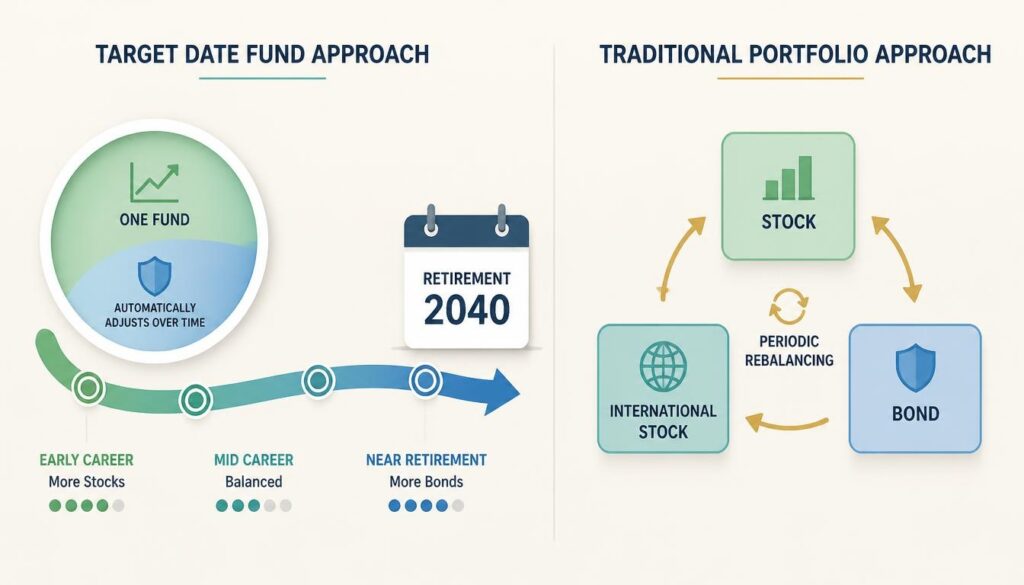
A target-date fund is one ticker that holds a mix of stocks, bonds, and sometimes other assets. You pick the fund whose year is closest to when you expect to retire (or simply need the money), then keep contributing. The fund automatically becomes more conservative as that year approaches. This is called a glide path. Early on the mix is usually heavily weighted toward stocks (often around 90 percent). Over time the stock portion declines and the bond portion rises.
Providers design the glide path differently. Some stop adjusting at the target year; others keep shifting for years afterward. The differences are real but secondary for most beginners. What matters more is that someone else is doing the work. Typical costs for the lowest-cost index-based versions run about 0.08 percent a year at places like Vanguard and Schwab, and roughly 0.12 percent for Fidelity’s index series. That is still low compared with many actively managed products, though higher than the underlying index funds themselves.
Next step: Look up the target-date fund already offered in your workplace plan or brokerage and note its expense ratio and approximate stock/bond mix today.
How a simple DIY index portfolio works
A basic DIY portfolio usually uses two or three funds: a total stock market fund (or separate U.S. and international stock funds) plus a total bond fund. You choose a starting mix—say 80 or 90 percent stocks if you are decades away from needing the money—and rebalance once or twice a year, or whenever the allocation drifts by a set amount. Lower fees are the main advantage. A blended three-fund portfolio at a low-cost provider often lands around 0.03 to 0.05 percent.
You are responsible for the mix and the rebalancing. That is the entire job. There is no automatic glide path; if you want the portfolio to become more conservative over time, you decide when and how to adjust it.
Next step: Decide whether a simple stock-and-bond mix of two or three funds feels manageable, or whether the idea of touching it even once a year already feels like one more task you will postpone.
The real differences that matter for beginners
Effort. A target-date fund is set-and-forget. A DIY portfolio requires occasional decisions. Will you actually open the account and rebalance, or will life get in the way?
Cost. DIY is usually cheaper. The gap is often around four basis points (0.04 percent) between the cheapest target-date funds and a simple index mix. On a $100,000 balance that is roughly $40 a year. Over 20–40 years the difference compounds into thousands of dollars, but it is not life-changing money for most people—especially if the simpler option keeps you invested through market drops.
Control. DIY lets you set your own stock/bond mix, skip international stocks if you prefer, or adjust later. A target-date fund locks you into the provider’s path.
Behavior. Many people never rebalance a DIY portfolio. Markets move, the allocation drifts, and the plan is forgotten. The target-date fund does the rebalancing for them.
Taxes. In taxable brokerage accounts, target-date funds can create more taxable events because they hold bonds (whose interest is taxed as ordinary income) and because internal rebalancing can generate capital-gains distributions. In retirement accounts such as a 401(k) or IRA the difference is much smaller. (Note: these account types are U.S.-specific; the underlying idea of tax location still applies in many other countries.)
Neither approach guarantees better results. The one that matches your willingness to manage it is the one more likely to stay invested.
A note for readers outside the United States
Similar one-fund lifecycle or target-date products and low-cost index options exist in many countries. The exact fund names and tax rules differ, but the same trade-offs apply: one fund that adjusts for you versus a small set of broad index funds you maintain yourself. Focus on the expense ratio, the glide path (or lack of one), and whether you will actually rebalance.
Next step: Write down your honest answer to two questions: Will I rebalance if no one else does it? Do I want the lowest cost or the least effort? That answer is the start of your decision.
When a target-date fund is usually the better choice
A target-date fund tends to be the better fit when you want the fewest decisions possible. If you already know you are unlikely to rebalance on your own—because work, family, or simple forgetfulness will get in the way—the automatic adjustments matter more than the extra few basis points in fees.
It is also a strong default when you are investing mainly inside a retirement account such as a 401(k) or IRA, where the tax differences are smaller. Many beginners simply need something they can start with and leave alone while they focus on increasing their savings rate. Early in your investing life, the biggest risk is often not starting at all.
You value simplicity more than shaving a few basis points. That preference is reasonable. The fund’s glide path and rebalancing are handled for you, which removes one common source of regret.
Next step: Check the expense ratio of the target-date fund available to you. If it is in the low range (roughly 0.08–0.15 percent for index-based versions), it is usually a practical place to begin.
When a DIY index portfolio is usually the better choice
A simple DIY index portfolio is usually the better match if you are comfortable checking the allocation once or twice a year and making small adjustments. The lower ongoing cost is the main advantage, and that edge compounds over decades if you actually maintain the mix.
You prefer to set your own stock/bond ratio rather than accept the provider’s path. Or you are investing in a taxable account and want more control over what generates taxable income each year. Some people also like the clarity of seeing the individual pieces instead of one combined fund.
You already have (or are willing to learn) a basic two- or three-fund approach. The learning curve is short: pick broad total-market funds, choose a starting percentage of stocks versus bonds, and rebalance on a simple schedule.
Next step: Write down a target mix (for example 90/10 or 80/20) and the two or three funds you would use. If that feels clear and doable, DIY is worth considering.
A practical way to decide and begin
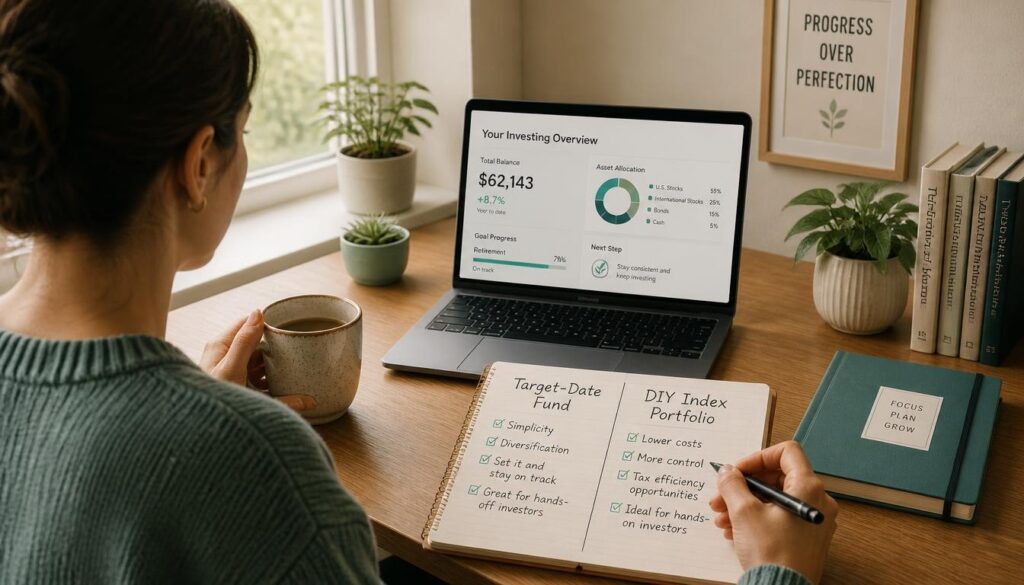
Ask yourself two questions:
Will I actually rebalance if no one else does it?
Do I want the lowest cost or the least effort?
Then pick one path and open the account. A lot of beginners delay for months because they think they have to get the perfect portfolio. Either approach is “good enough” for the first year—and for many years after—as long as you keep contributing.
How to choose a specific target-date fund.
Look at the expense ratio and glance at the glide path (how much stock it holds now and near the target year). Prefer an index-based version when available. The exact year you pick is less critical than starting; you can switch later if needed.
How to build a basic DIY mix without overcomplicating it.
Use a total stock market fund (or U.S. plus international) and a total bond fund. Set your starting percentage and plan to rebalance once a year or when it drifts by five percentage points. That is the whole system for most people.
What “good enough” looks like in the first year.
Money is going in regularly. The allocation is roughly where you intended. You are not checking the balance every day. You can always refine the approach later.
You have permission to start with the simpler option and change later. Many people begin with a target-date fund and later move to individual index funds once the account is larger or they feel more comfortable. The reverse is also fine.
Next step: Open the account this week and make the first contribution, even if it is small. The habit matters more than the perfect choice.
Common beginner mistakes with both
Switching back and forth between the two approaches usually adds cost and confusion without improving results. Adding extra funds “just in case” turns a simple portfolio into something harder to maintain. Ignoring the target-date fund’s fees can quietly erode returns if the plan offers only higher-cost options. Building a DIY portfolio and then never rebalancing lets the mix drift far from your original plan. Treating either approach as a reason to check the balance every day tends to increase anxiety more than returns.
The goal is a portfolio you can leave alone most of the time while you keep saving.
FAQs
Is a target-date fund good enough or am I leaving money on the table by not doing it myself?
For most beginners, a low-cost target-date fund is good enough. The fee difference versus a DIY mix is real but modest with the cheapest options. The bigger risk is delaying or abandoning the plan because it requires more attention.
How much more do target-date funds usually cost than a simple index portfolio?
With the lowest-cost index-based target-date funds, the gap is often around 0.04 percent a year (roughly $40 per year on a $100,000 balance). Higher-cost target-date funds in some workplace plans can cost several times more. The exact numbers matter less than whether the convenience keeps you invested.
Do I have to rebalance a DIY portfolio every year or can I just leave it?
You can leave it, but many people then discover years later that the mix has drifted far from what they intended. Once or twice a year, or when it drifts by a set amount, is enough for most.
Which one is better if I’m investing in a Roth IRA or 401(k)?
In these tax-advantaged accounts the tax differences shrink, so the choice comes down more to effort and cost. A target-date fund is often the simpler starting point inside a workplace plan. (These specific account names are U.S.-focused; the same idea applies to tax-advantaged retirement accounts elsewhere.)
Can I switch from a target-date fund to my own index funds later?
Yes. Many people do exactly that once the balance grows or they become more comfortable. In a retirement account the switch is usually straightforward. In a taxable account, check the tax consequences first.
What if I pick the wrong target year?
Choosing a year that is a bit earlier or later is rarely a disaster. The glide path changes gradually. You can switch funds later if your plans change.
Is this the same advice if I’m not in the United States?
The core trade-offs are the same: one fund that adjusts for you versus a small set of low-cost index funds you maintain. Look for local lifecycle or target-date products and low-cost broad index funds, then apply the same questions about effort, cost, and whether you will rebalance.
Should beginners just pick one and stop researching?
Yes. Pick the option that matches how much attention you are realistically willing to give, start contributing, and revisit only if your situation changes. Perfect is the enemy of started.
Both paths are reasonable. The better one is the one you will actually keep funding for decades.
This is general education, not personalized investment advice. All investing involves risk, including the possible loss of principal.