You pay something every month. Sometimes almost the full amount. Then interest appears anyway. The surprise usually comes from one rule: paying “something” is not the same as paying the full statement balance by the due date. One missed full payment can turn interest on for the whole cycle and for new purchases that follow. A lot of people only learn this after the fact and think, “I didn’t think it worked that way.”
The minimum payment keeps the account current and avoids a late fee. A partial payment reduces what you owe. Neither one protects you from interest the way paying the full statement balance does. Once the full amount is not paid by the due date, interest typically starts applying to the remaining balance and to new purchases from the day they are made.
Action: Look at your last statement. Did you pay the full statement balance by the due date, or something less?
APR, daily rate, and how interest is actually calculated
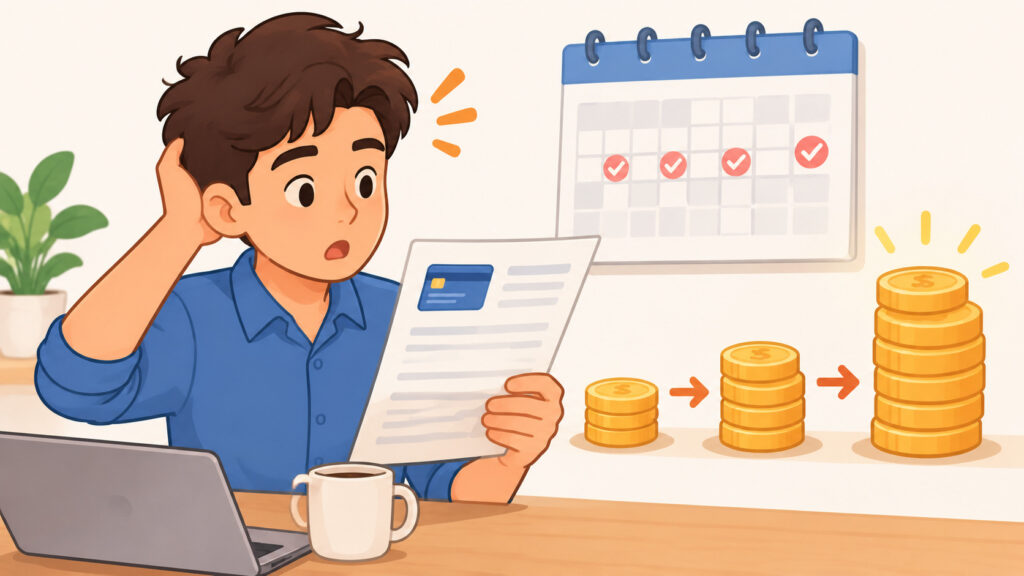
The annual percentage rate (APR) is the yearly cost of borrowing shown on your statement. Issuers turn that into a daily rate, most often by dividing the APR by 365. A 20% APR becomes roughly 0.0548% per day. Some issuers use 360 instead of 365. The difference is small but real. Your card agreement states which method applies.
Most U.S. issuers then use the average daily balance method. They record your balance at the end of each day in the billing cycle, add those daily balances together, and divide by the number of days in the cycle. That average is multiplied by the daily rate and by the number of days in the cycle.
Timing matters. A large purchase early in the cycle raises the average more than the same purchase near the end. A payment early in the cycle lowers the average more than the same payment later.
Simple example
Suppose your average daily balance for a 30-day cycle is $1,500 and your APR is 20%.
Daily rate ≈ 0.0548%.
Interest for the cycle ≈ $1,500 × 0.000548 × 30 ≈ $25.
That is the cost of carrying that average balance for one month when the grace period is not protecting you. Exact results can differ slightly if the issuer compounds interest daily (adding each day’s interest to the balance) or uses a different day-count convention.
Calculation methods and disclosure rules can differ outside the United States. Even within the U.S., your own card agreement and statement control the precise formula.
Action: Find the APR and interest-charge section on your last statement. Note whether interest was charged and what balance it was based on.
The grace period — what it is and when you get it

The grace period is the interest-free window on new purchases that most cards offer when you pay the full statement balance by the due date. Federal rules require issuers to deliver your statement at least 21 days before the due date, so the window is typically 21 to 25 days. During that time, purchases from the just-closed cycle cost no interest if the full statement balance is paid on time.
It applies to purchases. Cash advances and balance transfers usually start accruing interest on the day of the transaction and often carry a higher rate.
Key distinction
- Statement balance = the amount you owed when the billing cycle closed. This is the number that protects the grace period.
- Current balance = whatever you owe right now, including any purchases made after the statement closed.
- Minimum payment = the amount that keeps the account current but does not protect the grace period.
Paying the current balance is fine and can even help, but the grace period itself is triggered by paying the statement balance in full by the due date.
If you have been paying the full statement balance every month, new purchases are normally interest-free until the next due date. That is the main reason many people can use cards for convenience and rewards without paying interest.
On your last statement, locate the statement balance and the due date. Confirm whether that exact amount was paid by that date.
How you lose the grace period
You lose the grace period by:
- Carrying any balance from the previous statement
- Paying less than the full statement balance
- A payment that arrives after the due date (even one day late)
Once the grace period is gone, interest starts accruing on new purchases immediately—from the day each purchase posts—not from the next due date. The unpaid portion of the earlier balance continues to accrue as well.
The Consumer Financial Protection Bureau notes that if you pay in full some months and not others, you may lose the grace period for the month you missed and the month after. Exact recovery rules vary by issuer and are stated in the card agreement. In practice, many issuers restore the grace period after one or two consecutive on-time payments of the full statement balance.
A lot of people only notice the change after interest has already appeared on a statement they expected to be clean. The system is not required to send a special warning when the grace period ends; the statement itself shows the interest charge.
Action: Compare the payment you made last month with the statement balance shown on that statement. Was it the full amount, and did it post by the due date?
Residual interest and other quiet costs
A lot of people only learn about residual interest after they’ve already paid the balance in full. You clear the statement balance, expect the next bill to show zero interest, and still see a charge. That charge is residual (or trailing) interest.
It appears because interest was accruing every day between the statement closing date and the day your payment actually posted. Once the payment arrives, the balance stops growing, but the interest that built up in those intervening days is billed on the following statement. In our $1,500 / 20% example, a few days of residual interest might add only a few dollars, but the appearance is what surprises people.
The cleanest way to stop it is to pay the full amount shown on the statement, then check the next statement and pay any remaining residual interest in full as well. Some issuers let you request a payoff amount that already includes interest accrued through a certain date; paying that can reduce or eliminate the residual charge.
Minimum payments create another quiet cost. They are designed to keep the account current, not to retire the balance. On a carried balance, most of each minimum payment goes toward interest, so the principal shrinks slowly. Late fees and penalty APRs are separate issues that can appear if a payment is late or returned; they are not the same as ordinary interest, but they raise the total cost further.
Action: If interest appeared after you thought you had paid everything off, open the next statement and pay the full amount shown (including any residual interest) by its due date.
How to keep or regain the grace period
The most reliable habit is simple: pay the full statement balance by the due date every month. Setting up automatic payments for the full statement balance removes the chance of missing the date or paying a partial amount by accident.
If you have already lost the grace period, the usual path back is:
- Pay the full current balance (or at least the full statement balance) as soon as you can.
- Pay the next full statement balance by its due date.
- Often a second consecutive full statement-balance payment is required before the grace period fully returns on new purchases.
Many issuers restore the grace period after two consecutive on-time payments of the full statement balance; a few restore it after one. Your card agreement or a quick call to the issuer will confirm the exact number. While you are restoring it, new purchases continue to accrue interest from the day they post, so limiting new spending on that card speeds the process.
Once the grace period is active again and you continue paying the full statement balance each month, new purchases return to interest-free status until the following due date.
Action: Set up autopay for the full statement balance. If you have already lost the grace period, pay the current balance now and plan to pay the next full statement balance on time.
A practical way to check your own situation
Pull up your last statement and note three numbers:
- The due date
- The statement balance
- Any interest charged
Then check the payment that followed. Was it equal to the full statement balance, and did it post by the due date?
If interest already appeared this cycle:
- Pay the full amount shown on the current statement (or the current balance if it is higher) by the due date.
- Expect a possible residual-interest line on the following statement and pay that in full as well.
- After one or two consecutive full payments, confirm that new purchases are no longer accruing interest.
A short checklist before the next due date:
- Autopay set to the full statement balance?
- Payment scheduled to arrive on or before the due date?
- Any cash advances or balance transfers (which usually have no grace period) accounted for separately?
Action: Open your last statement right now and answer the three questions above. That single check tells you whether the grace period is currently protecting you.
FAQs
If I pay the full balance every month, do I really pay zero interest?
Yes, on purchases, if you pay the full statement balance by the due date every month and the card offers a grace period. Cash advances and balance transfers are usually excluded.
I paid almost the full amount — why am I still being charged interest?
Paying less than the full statement balance, even by a small amount, normally ends the grace period. Interest then applies to the unpaid portion and to new purchases from the day they are made.
How long does the grace period last?
Typically 21 to 25 days — from the statement closing date to the payment due date. Federal rules require the statement to be delivered at least 21 days before the due date.
I paid late once. How do I get the grace period back?
Pay the full statement balance (or current balance) on time for the number of consecutive cycles your issuer requires — often one or two. Check the card agreement or ask the issuer for the exact rule that applies to your account.
Why is interest still showing up after I paid everything off?
That is residual interest — the interest that accrued between the statement date and the day your payment posted. Pay the amount shown on the next statement in full and it should stop.
Does the grace period work the same on every card?
Most U.S. cards that offer a grace period follow the same basic rules, but the exact recovery period, day-count method, and treatment of balance transfers can differ. Always check your own card agreement.
What’s the difference between statement balance and current balance?
Statement balance is the amount owed when the billing cycle closed — the figure that protects the grace period. Current balance is what you owe right now, including any purchases made after the statement closed.
Is this the same if my card is from a bank outside the US?
No. Calculation methods, grace-period rules, and disclosure requirements can differ by country and by issuer. The principles above describe common U.S. practice; your card agreement is the final authority.
This is general education, not personalized advice. Exact terms vary by issuer and country — review your card agreement for the rules that apply to you.