The three payoff methods mainly differ in which balance you attack first: snowball chases the smallest balance, avalanche chases the highest interest rate, and a hybrid lets you mix the two so you get both emotional wins and solid math on the same set of debts. Snowball usually gives faster “I paid something off!” moments; avalanche usually wins on total interest; a simple hybrid can get you close to avalanche-level savings while still feeling doable month after month.
Why the method matters (and doesn’t)
Any focused extra payment on one target debt is better than spreading that extra across several and just rotating minimums, because concentrating payments knocks out balances faster and reduces future interest. Debt payoff calculators make this concrete by showing a finish date, total interest, and a month‑by‑month plan instead of vague hope.
The bigger risk is not “picking the wrong method,” but starting a plan, getting discouraged, and slipping back to minimums-only on everything. Minimums-only is how most people stay stuck in debt, not a character flaw, and your best method is the one you will keep following when motivation dips.
Decide that any consistent extra payment—no matter which method you choose—is already a win.
The three methods in plain language
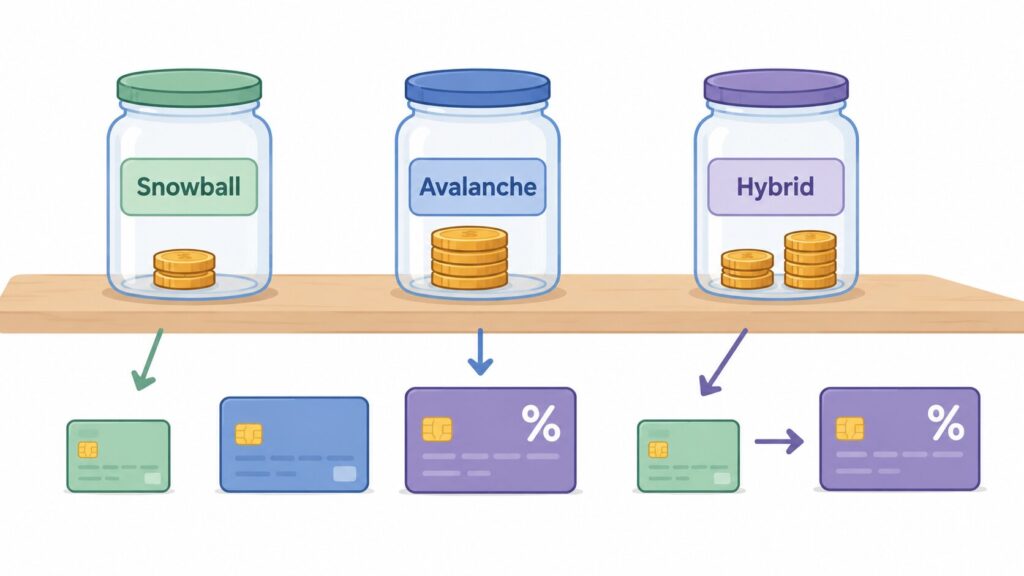
Snowball means you pay off the smallest balance first, regardless of interest rate, while making minimum payments on all other debts. Once that smallest debt is gone, you roll its whole payment (minimum + extra) onto the next-smallest balance, creating a “snowball” of growing payments.
Avalanche means you sort debts by interest rate from highest to lowest and attack the highest-rate debt first, again while paying minimums on everything else. Each time a high-rate debt disappears, you roll its payment down the list, which normally cuts your total interest cost the most if you stay consistent.
Hybrid is any deliberate mix: for example, you might wipe out one small balance for momentum and then switch to highest-rate-first on everything else, or run avalanche but make one exception for a small, annoying bill that messes with your head. Hybrid exists to optimize both feelings and math.
Next step: Decide whether you’re more worried about motivation (lean snowball), interest cost (lean avalanche), or want a mix (hybrid).
What you need before you open a calculator
Before you touch any calculator or spreadsheet, write down for each debt:
- Current balance
- Interest rate (APR)
- Minimum monthly payment
Then decide how much extra you can realistically add toward debt each month after essentials like rent, food, transport, and basic savings. That “extra” should be realistic—based on your actual cash flow—not aspirational, or your plan will collapse after a few hard months.
This same math works whether you’re in the US, India, Europe, or anywhere else; the only things that change are the loan types (credit cards, personal loans, BNPL, overdrafts) and typical interest rates in your country.
Next step: Make a simple list: one row per debt with balance, rate, and minimum, plus one line for “extra I can pay monthly.”
One worked example with real numbers
Let’s use one example household, keeping the numbers stable so you can see the trade‑offs clearly:
- Store card: 2,400 at 24% APR, minimum 60
- Credit card: 6,800 at 19% APR, minimum 150
- Car loan: 11,000 at 7% APR, minimum 220
- Personal loan: 4,100 at 12% APR, minimum 100
Assume they can put an extra 500 per month toward debt, on top of all minimums. Using standard amortization math and rolling payments as each balance hits zero, here’s roughly what happens when they apply different methods.
Example payoff comparison
| Method | First debt paid off | Months to debt‑free* | Approx. total interest* |
|---|---|---|---|
| Snowball | Store card → Personal loan | ~33 months | ≈ 3,600 |
| Avalanche | Store card → Credit card | ~32 months | ≈ 3,350 |
| Hybrid | Store card, then avalanche | ~32 months | ≈ 3,350 |
*These numbers are based on a month‑by‑month payoff simulation using the balances, rates, and minimums above plus a fixed 500 extra payment.
What this illustrates:
- Avalanche saves a few hundred dollars of interest versus snowball in this example, because it focuses early money on the highest‑rate debts.
- Snowball takes about one extra month and costs a bit more interest but kills smaller balances faster, which many people find more motivating.
- Our simple hybrid (clear the smallest balance, then switch to avalanche) happens to match avalanche’s math here because the smallest balance also has the highest rate; in many real‑world debt lists, a hybrid will sit somewhere between pure snowball and pure avalanche on total interest.
Sketch your own comparison—list your debts and try snowball, avalanche, and one simple hybrid scenario with the same total monthly payment.
How to use a payoff calculator without getting lost
Most debt payoff calculators or apps will ask you for:
- Each debt’s balance, APR, and minimum payment
- Your total monthly payment (minimums + extra)
- The method or “priority” (smallest balance vs highest rate)
Start by entering all debts and your total monthly payment, then choose either “snowball” or “avalanche” and hit calculate; you should see a payoff date, total interest, and a schedule of which debt is targeted first.
To model “What if I add 50 more?” just increase the total monthly payment by 50 and rerun—the payoff date moves earlier and the total interest drops. For a hybrid, many calculators don’t have a separate button, but you can “fake” it by:
- First, running snowball with your initial extra payment until a chosen small debt is gone (note roughly how many months that takes).
- Then, re‑running the rest of the debts in avalanche order with the now larger payment (because the paid‑off debt’s minimum has rolled in).
Whether you use a spreadsheet, a mobile app, or a web calculator, pick one tool and stick with it so you’re not constantly re‑learning interfaces. Always save, download, or screenshot the result so your plan lives somewhere more reliable than your memory.
Next step: Open one calculator or spreadsheet and enter your actual debts once; save the first scenario you run.
How to choose when the numbers are close
If avalanche saves only a little money—say a few hundred dollars over several years—while snowball gets you a paid‑off balance in the first 60 days, the motivational win may be the better investment. That early “I closed a card!” moment can be what keeps you on track through month 7 and 18.
On the other hand, if you have a very high‑interest card (25%+ APR) with a large balance, prioritizing it via avalanche or a hybrid that hits that card early is usually worth the delayed celebration, because every month you delay costs you more interest.
You should also factor in:
- Irregular income: If your extra payment fluctuates, pick a method and stick to the priority order, but accept that payoff dates will move.
- Couples who disagree: Treat the choice as a joint strategy discussion, not a moral referendum—“You prefer wins; I prefer interest savings; what compromise feels fair?”
- Mental load: It’s valid to say “I need one annoying account gone so I can think,” and build that into a hybrid even if it’s not strictly optimal.
Next step: Look at your own numbers: if avalanche’s dollar savings are small, give yourself permission to choose snowball or hybrid for motivation.
Turning the calculator result into a monthly ritual
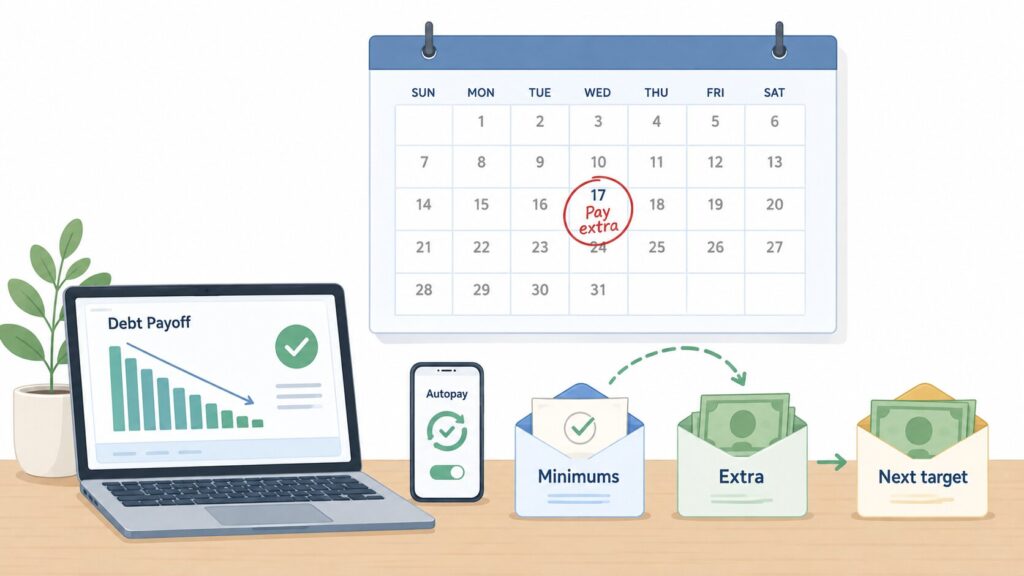
Once you’ve chosen a plan, turn the result into actions you repeat every month:
- Automate minimum payments on every debt to avoid late fees and penalty rates.
- Send all extra money to just one current target debt according to your chosen method.
- When a balance hits zero, roll that entire payment (minimum + extra) onto the next target—that snowball or avalanche effect is the part most people skip.
- Recalculate only when something meaningful changes: your income, a big new lump‑sum you can add, a major rate change, or a new debt. Not every week.
This turns your plan from a one‑time calculation into a simple monthly ritual: check balances, confirm autopay, send the extra, and celebrate each paid‑off account.
Next step: Set up auto‑minimums now, and create a recurring calendar reminder for “send extra payment to [current target]” each month.
Limits of what calculators can do
A calculator assumes you stop adding new balances and make the planned extra payment every single month; if spending keeps creating fresh debt or the extra disappears, the projection breaks. It also usually treats each APR as fixed and doesn’t fully capture promotional 0% periods, penalty rates, or variable‑rate products without manual tweaking.
Some loans have tax implications or special rules (for example, certain student loans, some business loans, or collections accounts) that need more nuanced handling than a generic payoff app provides. In cases where minimums are unaffordable, collectors are calling, or you’re considering settlement or bankruptcy, nonprofit credit counseling or professional advice is usually better than another spreadsheet.
Next step: Be honest: if minimums themselves feel impossible or collections have started, add “talk to a nonprofit counselor” to your to‑do list alongside using a calculator.
FAQ
Which method actually saves more money, or is snowball just a motivational trick?
Avalanche is designed to save the most interest because every extra dollar goes to the highest‑rate debt first. Snowball is built for motivation—quick wins by clearing smaller balances—even if that means you sometimes pay more interest overall. For many people, the extra interest is the price of a plan they actually follow, which may still be cheaper than quitting an avalanche plan halfway and drifting back to minimums-only.
Can you show me the same debts under all three methods so I can see the difference?
Using the example household (2,400 at 24%; 6,800 at 19%; 11,000 at 7%; 4,100 at 12%; plus 500 extra per month), a detailed payoff simulation suggests:
- Snowball: roughly 33 months to debt‑free, about 3,600 of interest.
- Avalanche: roughly 32 months, about 3,350 of interest.
- Simple hybrid (clear the smallest, then avalanche): roughly 32 months and similar interest to avalanche in this specific setup.
In other debt mixes, hybrid often lands between the two on both months and interest.
What if I can only put an extra 75 a month toward debt — is this even worth calculating?
Yes. Even a modest extra amount speeds things up if you keep it going, and a calculator will show you the new payoff date and interest reduction. Seeing that “just 75” might shave many months off your debt‑free date can make it feel much more worthwhile.
Is it okay to pay off a small high‑interest card first and then switch? Is that hybrid?
Yes—that’s a classic hybrid move. You might kill a small, high‑interest store card first, then switch to a strict avalanche for the remaining debts; or clear one or two nagging small balances, then go by interest rate. This is not cheating; it’s customizing the plan to your psychology.
Should I include my mortgage or student loans in this calculator?
Most people don’t include low‑rate, long‑term debts like mortgages in their snowball or avalanche list, because the interest rate is usually far lower than credit cards and personal loans, and the payoff horizon is decades. Some do include certain student loans, especially high‑rate private loans, but treat government‑backed loans with special forgiveness or relief options more carefully and sometimes separately.
What happens if I miss a month of extra payments — do I have to start over?
No. You just adjust your projection. Missing an extra payment delays your payoff date and increases total interest a bit, but you can pick up again next month with the same method. Think of your plan as a path you occasionally slow down on, not something that resets to zero.
My partner wants snowball and I want avalanche. How do we decide?
Treat it like any other shared money decision:
- Run both scenarios on the same debts and look at the actual difference in months and dollars.
- If the math difference is small, you might favor the method your partner feels they can stick with emotionally.
- If the difference is large because you have very high‑rate debt, consider a compromise hybrid that hits those high‑rate accounts early but still gives some quick wins.
This is about aligning on a shared plan, not deciding who is “right” about debt.
Are the online calculators trustworthy or should I build this in a spreadsheet?
Most reputable calculators from banks, major financial sites, or dedicated tools use standard loan formulas and will be accurate for normal installment and credit card debts. A spreadsheet gives you more control and transparency, but also more room for mistakes; if you’re comfortable with formulas, it’s great, otherwise a well‑known web or app‑based calculator is fine.
Before you pick a camp
Before you declare “I’m Team Snowball” or “I’m Team Avalanche,” pull your real balances and run at least one scenario with your actual numbers. Use the methods here as education, not personalized financial advice—rates, fees, and loan terms vary and can change, and big decisions deserve local, professional input when you’re unsure.
Your goal is not to be morally pure about method choice; it’s to pick a plan that is mathematically reasonable and emotionally sustainable so you actually reach “debt‑free.” If a hybrid that looks imperfect on paper is the one you’ll truly follow, it’s a perfectly valid choice.
Final step: List your debts, choose your total monthly payment, run snowball and avalanche once, and decide on the first target you’ll pay extra toward next month.