The backdoor Roth IRA is a U.S.-only tax strategy that lets high-income earners move money into a Roth IRA even when their income is above the direct Roth contribution limits. It works by contributing after-tax dollars to a traditional IRA on a non-deductible basis and then converting those dollars to a Roth IRA; the sequence is legal under current 2026 rules but comes with technical traps, especially the pro-rata rule and Form 8606 reporting.
This guide explains who the backdoor Roth is for, how it works step by step, how the pro-rata rule can make a conversion unexpectedly taxable, the most common mistakes, and when this strategy does or does not make sense. It is general education, not personalized tax advice, and assumes U.S. tax residency; tax rules and limits can change, so readers should verify current IRS guidance before acting.
Who the backdoor Roth is actually for
The backdoor Roth IRA is aimed at people whose income is too high to make a direct Roth IRA contribution under current IRS income limits, but who still want the long-term benefits of Roth tax treatment. In 2026, the modified adjusted gross income (MAGI) phase-out range for direct Roth contributions is roughly 153,000 to 168,000 for single filers and 242,000 to 252,000 for married couples filing jointly; above those amounts, direct Roth contributions are not allowed.
The backdoor Roth exists because the law caps who can contribute directly to a Roth IRA but does not impose income limits on either non-deductible traditional IRA contributions or Roth conversions. High earners effectively “back into” a Roth by first contributing to a traditional IRA with no deduction and then converting that balance to Roth, taking advantage of the absence of income limits on conversions.
This strategy is specific to the U.S. tax system, IRAs, and IRS rules, and generally does not apply to retirement accounts in other countries with different tax codes. Non-U.S. readers should not attempt to apply backdoor Roth mechanics to local accounts without local professional advice.
If your income is below the Roth IRA phase-out range and you can contribute directly to a Roth, a backdoor Roth is usually unnecessary; if your income exceeds the phase-out range and you are a U.S. taxpayer, the backdoor may be relevant.
What a backdoor Roth really is (and is not)
A backdoor Roth IRA is not a special type of account but a two-step process using ordinary IRA rules: contribute to a traditional IRA on a non-deductible basis, then convert that contribution to a Roth IRA. The traditional IRA contribution is after-tax because high income and workplace plan coverage limit or eliminate the deduction, creating after-tax “basis” inside the IRA that can be converted without being taxed again.investor.
By contrast, a regular Roth contribution is a direct contribution into a Roth IRA for someone under the income limits; no conversion step is involved, and the contribution itself is subject to annual Roth contribution limits and income phase-outs. A mega backdoor Roth is a different strategy involving after-tax contributions to a 401(k) plan above the regular deferral limit, followed by in-plan Roth conversion or rollover to a Roth IRA, and uses employer plan rules and much higher limits (up to total defined contribution limits like 72,000 in 2026).
The crucial distinction is that the backdoor Roth IRA uses individual IRA accounts (traditional and Roth) and the standard IRA contribution limit (7,500 in 2026, or 8,600 for those aged 50 and older), while the mega backdoor Roth uses workplace plans and different contribution caps. Both aim to increase Roth assets but rely on different parts of the tax code and different administrative steps.
If your plan involves a personal IRA and the 7,500 (or 8,600) annual limit, you are in backdoor Roth territory; if your plan involves large after-tax 401(k) contributions up to tens of thousands of dollars, you are in mega backdoor Roth territory.
Step-by-step: executing a backdoor Roth
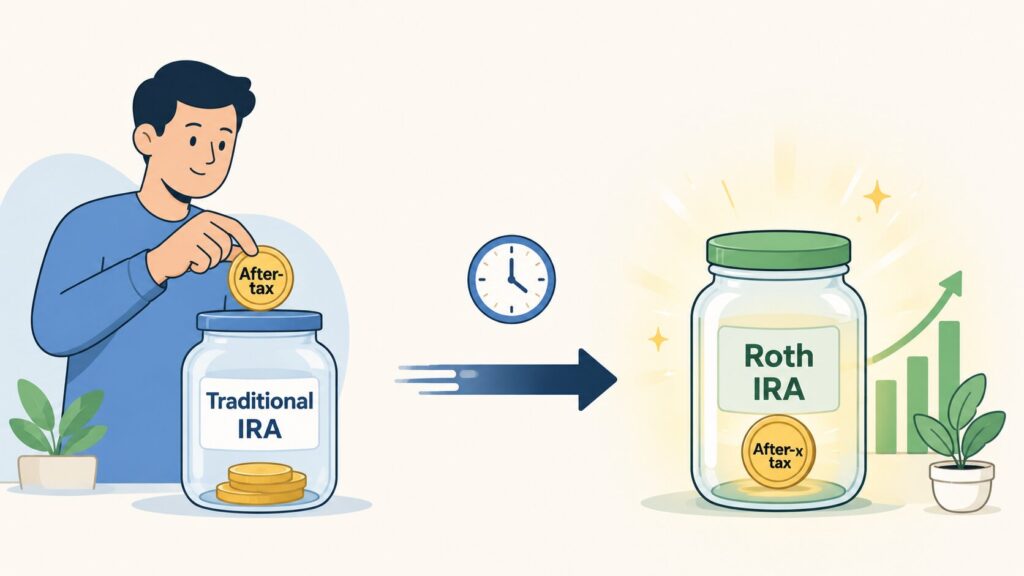
1. Confirm you can contribute to a traditional IRA
The first requirement is eligibility to contribute to a traditional IRA: you must have earned income (compensation) and be within the general IRA contribution framework. Traditional IRAs do not have income limits for making a contribution itself, only for deducting it; high earners can still contribute, they simply do not get a deduction.
You also need to stay within the overall IRA contribution limits for the year; in 2026, the limit is 7,500 per person (combined across traditional and Roth), with an additional 1,100 catch-up contribution for those aged 50 or older, for a total of 8,600. These limits apply per person per year, not per account or per strategy.Checkpoint: If you do not have earned income or have already used your full IRA contribution limit for the year via other IRA or Roth contributions, you cannot layer a backdoor Roth on top without causing excess contributions.
2. Make a non-deductible traditional IRA contribution
Next, open or use an existing traditional IRA at a brokerage and contribute up to the annual limit as a non-deductible contribution, meaning you will not claim a tax deduction for this amount on your tax return. For 2026, most guides illustrate a clean backdoor Roth by contributing the full 7,500 (or 8,600 if age 50+), though smaller amounts are allowed.investor.
When entering this contribution on your tax software or working with a preparer, you explicitly indicate that it is non-deductible, which creates after-tax basis in the traditional IRA and must be reported on IRS Form 8606. At the custodian level, you may simply designate the tax year and type of contribution; the tax treatment is ultimately determined on your return.
If you are unsure whether your IRA contribution is being treated as deductible or non-deductible, confirm with your tax software or preparer and plan to file Form 8606 for the contribution year.
3. Allow the contribution to settle and decide where the cash sits
Once contributed, the cash will typically land in the IRA’s core settlement fund or a money market fund and may need one to three business days to fully settle. Many advisers suggest leaving the funds in cash or a low-volatility money market during this brief window to minimize any gain or loss before conversion, because earnings between contribution and conversion will be taxable upon conversion.investor.
There is no IRS-mandated waiting period between contribution and conversion; same-day or near-immediate conversions are permissible, though some custodians prefer to wait until funds show as fully available. The practical decision is balancing administrative convenience (waiting for settlement) with tax simplicity (converting before material gains arise).
If you plan to convert quickly, consider leaving the IRA contribution in cash or a money market until the conversion is completed, to avoid unexpected taxable earnings.
4. Convert the traditional IRA to a Roth IRA
The core step is initiating a Roth conversion: instruct your brokerage to move the balance from the traditional IRA to a Roth IRA, ideally at the same institution for simplicity. Most custodians provide an online “Convert to Roth” or “Roth conversion” workflow in which you select the source traditional IRA, the destination Roth IRA, and the amount to convert; best practice for backdoor Roths is often to convert the entire traditional IRA balance tied to the new non-deductible contribution.investor.
If there were minimal or no earnings between contribution and conversion and you have no other pre-tax traditional/SEP/SIMPLE IRA balances, the conversion is largely tax-free because you already paid tax on the contributed amount. Any small earnings (for example, a few dollars of interest while sitting in a money market) are included in taxable income in the year of conversion as ordinary income.
If your traditional IRA holds only the recent non-deductible contribution and no other pre-tax funds, and you convert promptly, your conversion should be nearly tax-free apart from a small tax on any interim earnings.
5. Handle paperwork and tax reporting (Form 8606)
For each backdoor Roth transaction, you must report both the non-deductible contribution and the conversion on IRS Form 8606, Nondeductible IRAs. Form 8606 tracks your after-tax “basis” in traditional IRAs and calculates the taxable and non-taxable portions of distributions and conversions using the pro-rata rule.
Part I of Form 8606 records the current-year non-deductible contribution and total basis; Part II records the amount converted to Roth and applies the pro-rata calculation across all traditional, SEP, and SIMPLE IRAs. The form must be filed with your Form 1040 for any year you make a non-deductible traditional IRA contribution, convert traditional IRA money to Roth, or take distributions from an IRA with basis.
If you executed a backdoor Roth during the year but do not see Form 8606 in your draft tax return, revisit your entries or consult a preparer; missing the form is one of the most common errors.
The pro-rata rule: the biggest trap
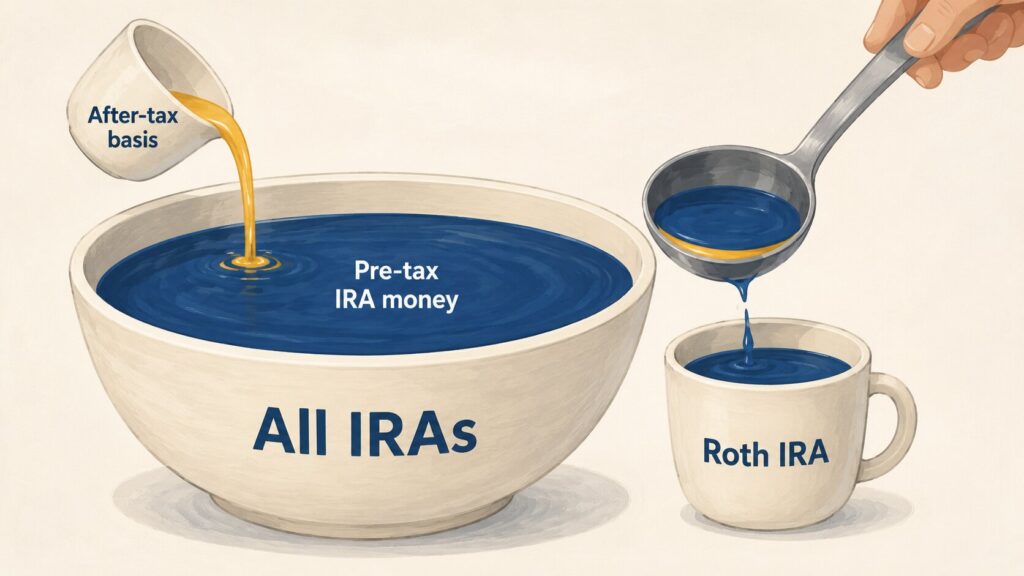
How the IRS aggregates your IRAs
The IRS does not look at each traditional IRA in isolation when you convert; instead, it aggregates the balances of all traditional, SEP, and SIMPLE IRAs you own and treats them as one combined IRA contract for tax purposes. Form 8606 uses the total value of all such IRAs as of December 31 of the tax year (plus certain rollovers) to compute what fraction of any distribution or conversion is tax-free return of basis and what fraction is taxable.
This means that if you have large pre-tax balances in existing IRA accounts and then contribute a small amount of after-tax basis for a backdoor Roth, any conversion will be only partially tax-free; the rest will be taxed according to the ratio of basis to total IRA value. Many taxpayers discover this only after the fact, when the pro-rata calculation on Form 8606 shows that most of their conversion is taxable.
Before making a backdoor Roth contribution, list all traditional, SEP, and SIMPLE IRAs you own and their December 31 balances; if you have substantial pre-tax balances, you must factor in the pro-rata rule.
Simple pro-rata examples
Consider an investor with 92,500 in a rollover IRA from a prior employer and no existing basis; during the year, they contribute 7,500 as a non-deductible contribution to a separate traditional IRA and then convert 7,500 to a Roth IRA. Form 8606 treats all traditional IRAs as one combined pot worth 100,000 (92,500 existing pre-tax plus 7,500 new basis) as of year-end; the basis is 7,500, so the non-taxable fraction is 7,500 divided by 100,000, or 7.5 percent.u
If they convert 7,500, only 7.5 percent (about 562.50) of the conversion is treated as tax-free return of basis, and the remaining 6,937.50 is taxable as ordinary income; the remaining basis is carried forward for future years. The taxpayer may have expected a tax-free conversion but instead finds that most of the converted amount is taxable due to the pro-rata rule.
By contrast, if someone has no other traditional/SEP/SIMPLE IRA balances and contributes 7,500 non-deductible to a new traditional IRA, then converts the entire 7,500 before any earnings, the pro-rata fraction is 100 percent basis and the conversion is effectively tax-free. This is the “clean” backdoor Roth scenario most guides describe.
If any of your traditional, SEP, or SIMPLE IRAs hold pre-tax money at year-end, expect a portion of your backdoor Roth conversion to be taxable; only a situation with no other pre-tax IRA balances yields a fully tax-free conversion.
Strategies to “clean up” pre-tax IRA balances
Many high earners address the pro-rata problem by rolling pre-tax IRA balances into an active workplace 401(k) or similar plan, which is not counted in the IRA aggregation for Form 8606. If the employer plan accepts incoming IRA rollovers, an investor can move their pre-tax traditional, SEP, or SIMPLE IRA balances into the plan before December 31 of the year they intend to execute the backdoor Roth.
Once the rollover is complete, their traditional IRA may hold only the new non-deductible contribution, producing a clean, nearly tax-free conversion; this approach is common among those with large rollover IRAs from prior employers. In other cases, people decide the pro-rata complication and additional tax bill make the backdoor Roth unattractive compared with simply investing in a taxable brokerage account.
If you have significant pre-tax IRA balances and access to a 401(k) that accepts rollovers, explore whether consolidating pre-tax funds into the plan can create a cleaner backdoor Roth; if not, consider whether the partially taxable conversion is still worthwhile.
Common mistakes that create tax bills or headaches
Failing to file Form 8606
One of the most frequent mistakes is failing to file Form 8606 for a non-deductible contribution and/or Roth conversion; without the form, the IRS has no record of your basis and may treat the entire conversion or later distributions as taxable. Properly completed Form 8606 acts as a running ledger of your after-tax basis in traditional IRAs and is essential to avoid double taxation on future distributions.
Taxpayers who discover years later that they omitted Form 8606 for prior non-deductible contributions can often correct this by filing late or amended Forms 8606 and reconstructed records, but the process can be tedious. Good record-keeping and consistent filing, starting with the first backdoor Roth year, avoids this problem.
After every year in which you make a non-deductible IRA contribution or convert to Roth, verify that Form 8606 is included with your filed return and keep a copy with your permanent records.
Converting while other pre-tax IRA balances exist (pro-rata surprise)
Another common mistake is executing a backdoor Roth conversion while holding sizable pre-tax balances in other traditional, SEP, or SIMPLE IRAs, then being surprised when most of the conversion is taxable due to the pro-rata rule. Many backdoor Roth articles emphasize the “tax-free” nature of the conversion but only mention the aggregation rule in passing, leading to misunderstanding.
Once the conversion is done, the tax implications are governed by the pro-rata fraction; the only way to reduce the taxable portion for future years is to change the balance mix (for example, rolling pre-tax funds into a 401(k)) before subsequent conversions, but the original year’s conversion remains subject to that year’s pro-rata calculation. Taxpayers often learn about the pro-rata rule only when their software produces an unexpected tax bill.
Before converting any amount for a backdoor Roth, verify that your total traditional/SEP/SIMPLE IRA balances are either zero or minimal; otherwise, expect the pro-rata rule to make much of the conversion taxable.
Misunderstanding recharacterization and “undoing” a conversion
In the past, taxpayers could recharacterize (undo) Roth conversions, but changes under the Tax Cuts and Jobs Act eliminated the ability to recharacterize conversions made in 2018 or later; today, Roth conversions are generally irrevocable. Recharacterization remains available only for annual contributions—switching a contribution from Roth to traditional or vice versa by a deadline such as October 15 of the following year—but not for conversions of pre-tax funds.
This distinction matters for backdoor Roths: if you mistakenly make a direct Roth contribution when over the income limit, you can still recharacterize that contribution to a traditional IRA and then potentially use a backdoor Roth; but if you complete a Roth conversion, you cannot later recharacterize it back to traditional. Confusing these rules can lead to failed attempts to undo a conversion that the IRS now treats as permanent.
Treat any Roth conversion you perform as permanent; if you need to correct a mistaken Roth contribution, explore recharacterization with your custodian before the October 15 deadline.
Missing deadlines or contributing more than allowed
Excess IRA contributions (amounts above the annual limit or made ineligible circumstances) can trigger penalties if not corrected; the IRS typically imposes a six percent excise tax per year on excess contributions that remain in the account. Backdoor Roth users can inadvertently create excess contributions by double-counting contributions, mislabeling tax years, or contributing when not eligible.
Recharacterization and withdrawal of excess contributions, including associated earnings, are the main tools to fix such issues, but they must be completed by the tax filing deadline (often October 15 with extension) to avoid ongoing penalties. Good practice is to verify contribution limits and eligibility each year and to coordinate between spouses to avoid exceeding individual caps.
Before making a backdoor Roth contribution, confirm how much you and (if applicable) your spouse have already contributed to IRAs for the year and ensure total contributions per person stay within the limit.
Assuming every backdoor Roth conversion is tax-free
A frequent misconception is that all backdoor Roth conversions are tax-free because the contribution was made with after-tax dollars; in reality, tax outcomes depend on the pro-rata rule and any gains before conversion. If there are pre-tax balances in traditional IRAs or if the contributed amount grows before conversion, some portion of the conversion will be taxable.
Even in a clean backdoor scenario with no other IRA balances, small earnings between contribution and conversion (for example, from a money market fund) will be taxed as ordinary income at conversion; this is usually minor but still shows up on Form 8606 and Form 1099-R. Over time, repeated backdoor contributions with imperfect timing can accumulate taxable earnings if conversions are delayed.
Expect a truly tax-free conversion only if you have no other pre-tax IRA balances and convert your non-deductible contribution quickly before any meaningful earnings accrue.
Ignoring state tax treatment
Some states differ from federal rules in how they tax IRA contributions and Roth conversions; for example, a state may tax Roth conversion income differently or may not conform fully to federal tax law changes. Backdoor Roth conversions that are neutral or beneficial at the federal level may generate additional state tax liability depending on the state’s rules.
Comprehensive state-specific guidance is often required, especially for residents of high-tax states where additional state tax on conversions can materially change the after-tax outcome. Many backdoor Roth resources explicitly recommend consulting a tax professional familiar with state rules before executing the strategy for large amounts.
If you live in a state with income tax, review your state’s treatment of Roth conversions or consult a tax professional to understand the combined federal and state impact.
Losing track of basis over multiple years
Over time, repeated non-deductible contributions and conversions can create a complex basis history; failing to track basis accurately can lead to double taxation or misreported conversions. Form 8606 line 14 carries your cumulative basis forward each year, and this number becomes the starting point for the next year’s calculations.
If prior Forms 8606 were never filed or were misplaced, taxpayers may need to reconstruct basis using past contribution records, Forms 5498, and custodian statements, and then file late Forms 8606 or amended returns to correct the IRS record. This process is possible but time-consuming, emphasizing the importance of accurate record-keeping from the start.
If you plan to use the backdoor Roth strategy repeatedly, keep a dedicated file (digital or physical) with all Forms 8606, contribution confirmations, and custodian statements to track your basis year after year.
When the strategy makes sense—and when it does not
Benefits of a successful backdoor Roth
When executed correctly in a clean scenario (no other pre-tax IRA balances), the backdoor Roth provides access to Roth IRA benefits for high-income earners who would otherwise be locked out of direct contributions. Roth IRAs offer tax-free growth, tax-free qualified withdrawals in retirement, and no required minimum distributions (RMDs) during the original owner’s lifetime, which adds flexibility in managing taxable income later in life.
Roth IRAs can also be advantageous for heirs, as many beneficiaries will still receive tax-free distributions over the applicable post-death distribution period, subject to evolving rules; building a Roth “bucket” can diversify future tax exposure compared with traditional pre-tax accounts. For those expecting higher tax rates in retirement or who value flexibility, this can be an attractive trade-off.investor.
If you are a high-income earner with no other IRA balances, a long investment horizon, and a desire for tax-free retirement withdrawals, a carefully executed backdoor Roth can be a strong tool.
Situations where it may be less attractive
If you hold significant pre-tax IRA balances and cannot or do not want to roll them into a 401(k), the pro-rata rule may make each backdoor Roth conversion substantially taxable, reducing the incremental benefit of the strategy. In such cases, the after-tax difference between a backdoor Roth and simply investing in a taxable brokerage account may be modest, especially if the taxable account is used for tax-efficient investing.
Backdoor Roth contributions are also less compelling if your current marginal tax rate is relatively low and expected to be lower or similar in retirement, or if you may need the contributed funds relatively soon; Roth IRA five-year rules and penalties for early withdrawals can limit flexibility. Finally, legislative risk exists: while backdoor Roths are legal in 2026, Congress has periodically discussed eliminating the strategy, and future law changes could affect its value.
If the pro-rata rule would heavily tax your conversion or if your current and future tax rates are uncertain, consider modeling scenarios or speaking with a planner before committing to a multi-year backdoor Roth strategy.
Comparing to a taxable brokerage account
For some investors, simply investing after-tax dollars in a taxable brokerage account is a simpler alternative; taxable accounts offer full flexibility, no contribution limits, and favorable long-term capital gains rates on qualified holdings. The trade-off is that dividends and realized gains are taxed along the way, whereas Roth IRAs shield all internal growth from tax.
If the backdoor Roth can be executed with minimal or no additional tax (clean pro-rata situation), the Roth usually offers superior after-tax growth for long-term retirement goals, especially for assets expected to appreciate significantly. When the pro-rata rule or state taxes make the conversion expensive, the benefit margin narrows, making taxable investing a reasonable alternative.
If executing a clean backdoor Roth is straightforward and low-cost in your situation, it typically beats a taxable account for long-term retirement dollars; if the tax cost is high, compare outcomes before proceeding.
Record-keeping and tax filing
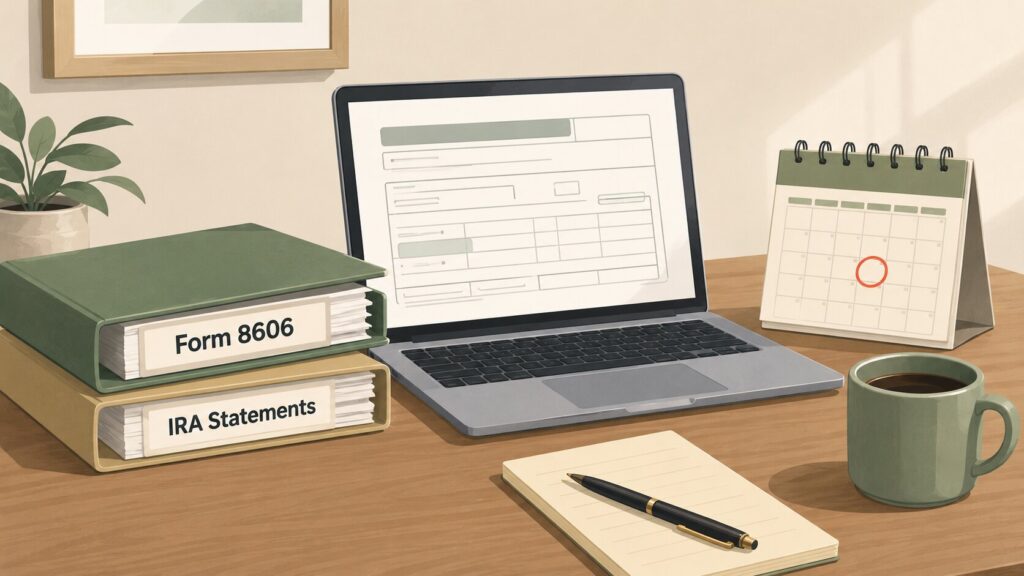
What records to keep
Effective use of the backdoor Roth strategy depends heavily on accurate records; key documents include contribution confirmations, year-end IRA statements, conversion confirmations, Forms 1099-R reporting conversions, Forms 5498 reporting IRA contributions, and all filed Forms 8606. These documents collectively establish your basis, track conversions, and document how much of your IRA balances has already been taxed.
Because basis can carry forward for decades, many experts recommend keeping Form 8606 and related records permanently rather than relying on the IRS to maintain complete history. Digital organization—such as a dedicated folder per tax year plus a master basis summary—can make this easier.
Start a dedicated “Roth and IRA basis” file (physical or digital) the first year you use the backdoor Roth strategy and add each year’s Form 8606, statements, and tax forms to it.
How the conversion appears on your tax return
A backdoor Roth year typically produces several tax form entries: the non-deductible traditional IRA contribution is reported via Form 8606 and may not appear as a deduction on Schedule 1, while the conversion generates a Form 1099-R from the custodian, which feeds into Form 1040 as part of gross income with the taxable portion calculated via Form 8606. Tax software often asks a series of questions about IRA contributions and conversions, then fills Form 8606 in the background.
Form 8606’s pro-rata calculation determines the non-taxable and taxable portions of the conversion, with the non-taxable portion representing a return of basis and the taxable portion treated as ordinary income. The final numbers flow to Form 1040, so a mis-entered basis or missed pre-tax balance can change your reported taxable income.
When reviewing your tax return, confirm that Form 8606 shows your non-deductible contribution on line 1, your total basis on line 2, and a reasonable taxable amount on the conversion lines, given your IRA balances.
Practical next steps and when to get help
Simple checklist for a “clean” backdoor Roth
For someone with no existing traditional/SEP/SIMPLE IRA balances and a straightforward tax situation, a basic checklist can guide a clean backdoor Roth:
- Confirm income is above the direct Roth IRA limit but you are eligible to contribute to a traditional IRA.
- Verify you have no pre-tax balances in traditional, SEP, or SIMPLE IRAs at year-end.
- Open a traditional IRA and Roth IRA at the same custodian if not already in place.investor.
- Contribute up to the annual limit to the traditional IRA as a non-deductible contribution, leaving it in cash or a money market fund.
- After settlement, convert the entire balance to the Roth IRA promptly.
- At tax time, ensure Form 8606 is filed, correctly showing the non-deductible contribution and conversion.
If each step checks out and the pro-rata rule does not apply, the backdoor Roth can often be completed annually with minimal friction.
If you can run through the above checklist without encountering complications (no other IRAs, clear income situation, comfort with tax software), you may be able to implement a backdoor Roth with limited professional help.
When to consult a tax professional or financial planner
Complex situations warrant professional guidance: for example, significant pre-tax IRA balances, mixed deductible and non-deductible contributions over many years, multiple conversions, complex state tax environments, or uncertainty about prior basis filing. In such cases, a CPA or enrolled agent can help model different options, clean up basis records, and ensure proper Form 8606 reporting.
A financial planner can also help determine whether the backdoor Roth aligns with broader retirement and tax planning goals, such as balancing Roth conversions with other income, managing future RMDs, or planning for heirs. Given that Roth conversions are now irrevocable and that tax laws may change, many high earners choose to run scenarios before committing to long-term multi-year backdoor Roth strategies.investor.
If you already have IRA balances, are unsure of your basis, or are contemplating large or repeated backdoor Roth conversions, consider consulting a tax professional before executing the strategy.
FAQs
Can I still do a backdoor Roth if I already have money in a traditional IRA?
Yes, you can technically execute a backdoor Roth even if you have existing traditional IRA balances, but the pro-rata rule will apply and make part of your conversion taxable by spreading your basis over all IRAs. Some investors address this by rolling pre-tax IRA balances into a 401(k) before doing a backdoor Roth, effectively “clearing the deck,” while others accept the partially taxable conversion or opt out of the strategy.
Is the conversion really tax-free or am I going to get a surprise bill?
The conversion is effectively tax-free only if your traditional/SEP/SIMPLE IRAs contain only the non-deductible contribution being converted and you convert before any meaningful gains; otherwise, the pro-rata rule and interim earnings can make part of it taxable. Many people are surprised by tax due when they have other pre-tax IRA balances or when they invest the contribution and let it grow before converting.
How long do I have to wait between the contribution and the conversion?
There is no IRS-imposed waiting period between contributing to a traditional IRA and converting it to a Roth; same-day or near-immediate conversions are allowed under current rules. Many practitioners suggest waiting one to three business days for the contribution to settle and then converting as soon as practical to minimize gains or losses.
What is the pro-rata rule in plain English?
The pro-rata rule says that when you take money out of your traditional, SEP, or SIMPLE IRAs—including for a Roth conversion—each dollar you take out is treated as a mix of after-tax basis and pre-tax money, in proportion to how much of your total IRA balance is basis versus pre-tax. You cannot choose to convert only the after-tax dollars; the IRS forces you to spread basis across all distributions.
Do I have to file an extra form every year for this?
You must file Form 8606 in any year you make a non-deductible traditional IRA contribution, convert from traditional/SEP/SIMPLE IRA to Roth, or take a distribution from an IRA that has basis; this is often every year you perform a backdoor Roth. The form tracks your basis and ensures that after-tax dollars are not taxed again.
What if I make a mistake—can I undo it?
If the mistake is an ineligible Roth or traditional IRA contribution (for example, contributing directly to a Roth when over the income limit), you may be able to recharacterize the contribution to the other type of IRA or withdraw the excess by the tax deadline, usually October 15 of the following year. However, if the mistake is an actual Roth conversion, conversions made in 2018 or later cannot be recharacterized or undone; you may only manage the tax impact going forward.
Is this still allowed in 2026 or did the rules change?
As of mid-2026, backdoor Roth IRAs remain legal and widely used; no law has been passed that bans non-deductible traditional IRA contributions or subsequent Roth conversions for high earners. While legislative proposals have occasionally targeted the strategy, none have taken effect, so the two-step backdoor remains available under current law.
Should I just put the money in a taxable brokerage account instead?
For investors who can execute a clean backdoor Roth with little or no additional tax, the Roth typically offers better long-term after-tax growth than a taxable brokerage account because all future income and gains on Roth investments are tax-free. However, when the pro-rata rule makes conversions significantly taxable or when state taxes are high, the advantage narrows, and a taxable account’s simplicity and flexibility may outweigh the incremental benefit of the backdoor.
If a clean backdoor Roth is easy for you and aligns with your long-term retirement plan, it is often worth doing; if it is messy, expensive, or confusing, a taxable brokerage account is a perfectly respectable alternative.